

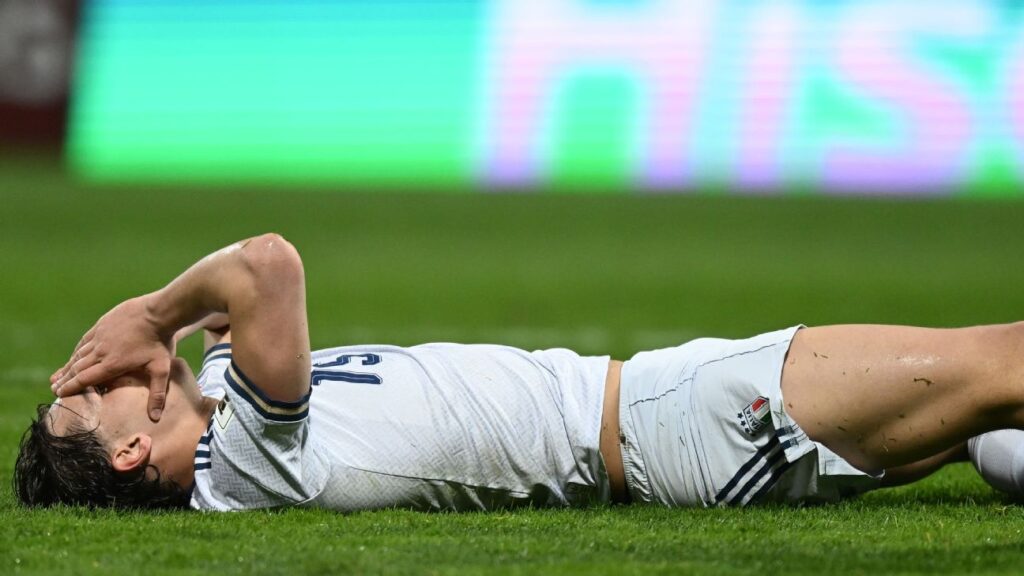
For decades, Italy stood as one of the defining powers of international football. With four FIFA World Cup titles, legendary players like Paolo Maldini, Fabio Cannavaro, Andrea Pirlo, and Roberto Baggio, and a tactical identity rooted in defensive mastery, the Azzurri were considered almost untouchable on the global stage. That is why the news that Italy fails to qualify for World Cup third straight time has shocked fans and experts alike.
Yet in 2026, history delivered a shocking verdict: Italy failed to qualify for the FIFA World Cup for the third consecutive time, missing the tournaments in 2018, 2022, and now 2026. This unprecedented collapse marks the deepest crisis in modern Italian football and represents one of the most dramatic declines in the sport’s history.
According to reports, Italy’s latest failure came after a devastating playoff loss to Bosnia and Herzegovina, sealing their third straight absence from the tournament.
This article explores how Italy reached this historic low, why the decline has persisted for over a decade, and what it means for the future of one of football’s most iconic nations.
Italy’s current crisis becomes even more striking when viewed through historical context. The national team:
As multiple reports confirm, Italy has become the first World Cup-winning nation in history to miss three consecutive tournaments.
This collapse is not an isolated incident—it is part of a long-term downward trajectory spanning nearly two decades.
Italy’s road to the 2026 World Cup ended in familiar heartbreak. After failing to secure automatic qualification in their group, they entered the playoff system—an arena that has become synonymous with Italian disappointment.
The decisive match against Bosnia and Herzegovina ended in a dramatic penalty shootout loss after a 1–1 draw in regulation time. A red card during the match shifted momentum, and Italy ultimately fell 4–1 in penalties.
This defeat mirrored earlier eliminations:
The pattern is clear: Italy repeatedly fail at the final qualification hurdle, often against lower-ranked opposition.
One of the most overlooked aspects of Italy’s decline is psychological pressure. Once a team accustomed to winning finals and competing at the highest level, the modern Azzurri now face increasing anxiety in decisive matches.
Players and analysts have pointed to recurring themes:
This psychological fragility has become a defining trait of Italy’s recent qualification campaigns.
One of the most frequently cited reasons for Italy’s decline is the absence of world-class generational talent compared to previous eras.
The golden generation of the 1990s and 2000s featured players such as:
Today’s squad, by contrast, is considered competitive but not elite at the global level. As one analysis noted, even top players like Sandro Tonali are not yet comparable to previous Italian legends.
The lack of a dominant striker and creative midfield maestro has particularly hurt Italy in tight qualification matches where individual brilliance often decides outcomes.
Beyond player quality, deeper systemic issues have contributed to Italy’s long-term decline.
Key structural challenges include:
Many analysts argue that Italian football has failed to modernize at the same pace as nations like France, England, and Spain, which have built strong youth pipelines and integrated advanced development systems.
Recent commentary also highlights that club priorities often conflict with national team preparation, limiting training cohesion and long-term squad development.
Italy’s domestic league, Serie A, was once the strongest in the world. Today, it remains competitive but no longer dominant in European competitions.
Key concerns include:
This has directly impacted national team depth. When domestic leagues fail to produce elite players consistently, national teams inevitably suffer.
Italy’s traditional identity was built on defensive discipline and tactical organization, famously known as catenaccio. However, modern football demands flexibility, high pressing, and attacking fluidity.
Italy has struggled to evolve consistently:
As a result, Italy often dominates possession but fails to convert chances—one of the key reasons behind their repeated playoff failures.
The 2022 World Cup qualification failure remains one of the most symbolic moments of Italy’s decline.
Despite dominating North Macedonia with over 30 shots, Italy lost to a last-minute goal from their only shot on target. That defeat exposed two major weaknesses:
This match is often cited as the turning point that confirmed Italy’s long-term crisis was structural, not accidental.
The Italian public response to the 2026 failure has been emotional and intense. Fans describe the situation as unthinkable for a nation that once considered World Cup qualification automatic.
Common sentiments include:
Some supporters have even called for structural reform of Italian football governance, reflecting deep frustration with the system.
Italy is not the only traditional powerhouse to experience decline, but its situation is unique in severity.
For comparison:
Italy, however, remains stuck in a prolonged downturn spanning nearly 20 years, with no stable recovery cycle.
Despite the crisis, Italy’s football future is not without hope. Several pathways for recovery exist:
However, these changes require time, patience, and structural reform—none of which guarantee immediate results.
Italy’s failure to qualify for a third consecutive World Cup is more than a sporting disappointment—it is a symbol of deep structural decline in one of football’s most historically successful nations.
From World Cup champions in 2006 to repeated qualification failures in 2018, 2022, and 2026, the Azzurri’s trajectory reflects a combination of talent gaps, tactical confusion, and systemic weaknesses within Italian football.
While the passion for football in Italy remains unmatched, passion alone is no longer enough to compete at the highest level.
The challenge now is not just qualification—it is reinvention. Whether Italy can rebuild its identity and return to the World Cup stage will define the next era of its footballing history.
What is certain is that the world of football is watching closely, waiting to see if a fallen giant can rise again.