

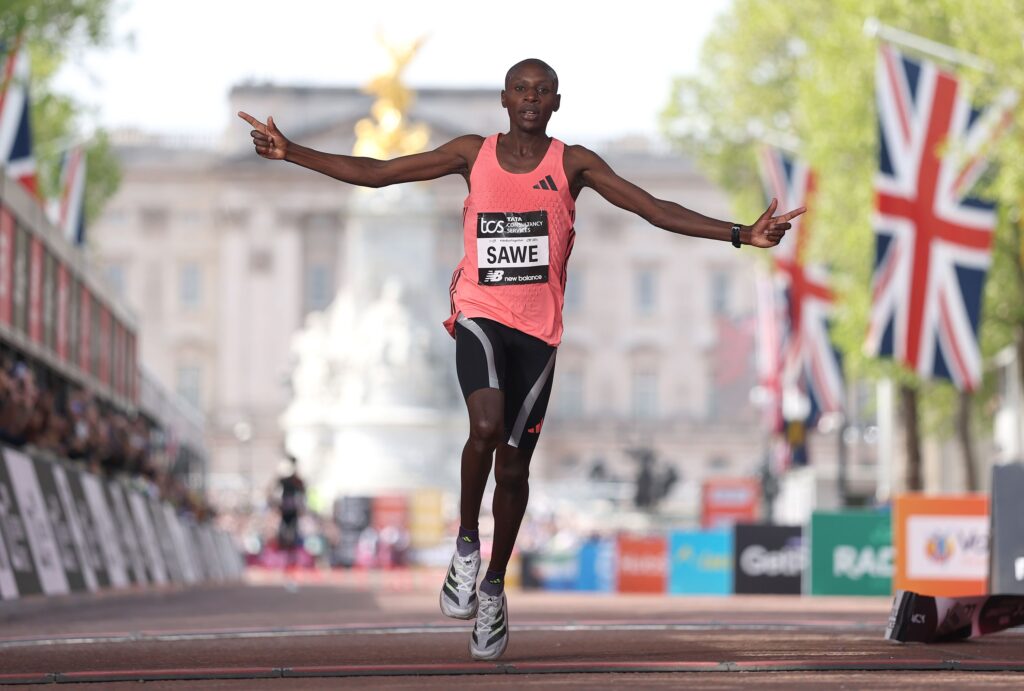
On an unforgettable spring morning in London, Kenyan marathon runner Sabastian Sawe achieved what generations of athletes, coaches, scientists, and sports fans once believed impossible: he officially ran a marathon in under two hours during a competitive race. Sabastian Sawe Runs Sub-Two Hour Marathon in London became the headline achievement in marathon history as Sawe crossed the finish line of the 2026 London Marathon in an astonishing time of 1:59:30, becoming the first person in history to break the two-hour barrier under official race conditions.
The achievement instantly became one of the defining moments in sports history. Comparisons were quickly made to Roger Bannister’s four-minute mile in 1954, a feat that forever changed perceptions of athletic possibility. Just as Bannister shattered psychological and physical boundaries, Sawe’s performance transformed marathon running forever.
The historic race at the London Marathon was not merely about one extraordinary athlete. It represented the culmination of decades of advances in sports science, nutrition, shoe technology, training methodologies, pacing strategies, and human determination. It also symbolized the continued dominance of East African runners in long-distance athletics and demonstrated how marathon running has evolved into one of the most scientifically optimized sports in the world.
This article explores Sabastian Sawe’s historic sub-two-hour marathon, the significance of the London race, the science and technology behind the achievement, reactions from the athletics world, and what this milestone means for the future of endurance sports.
The 2026 London Marathon will forever be remembered as the race where the impossible finally became reality.
Sabastian Sawe completed the 26.2-mile (42.195 km) course in 1 hour, 59 minutes, and 30 seconds, officially breaking the two-hour marathon barrier in a record-eligible race for the first time.
The previous official world record had been held by the late Kelvin Kiptum, who ran 2:00:35 at the 2023 Chicago Marathon. Sawe’s performance lowered the world record by an extraordinary 65 seconds—an enormous margin in elite marathon running.
What made the race even more remarkable was the depth of competition:
The race instantly became one of the greatest marathon events ever staged.
Before his historic London triumph, Sabastian Sawe was already considered one of the fastest rising stars in distance running.
Born in Kenya, Sawe emerged through the country’s famously competitive running culture, where thousands of athletes dream of achieving global success.
Kenya has long dominated long-distance running, producing legendary marathoners such as:
Sawe’s rise to global prominence accelerated after his stunning marathon debut in Valencia in 2024, where he ran 2:02:05—the second-fastest debut marathon in history at the time.
His performances signaled exceptional potential, but few predicted he would become the first man to officially break two hours.
For decades, the sub-two-hour marathon was viewed as one of the ultimate frontiers in sports.
The marathon demands extraordinary endurance, efficiency, mental resilience, and physiological capacity.
To run under two hours, an athlete must maintain an average pace of approximately:
That pace must be sustained continuously for over 42 kilometers.
Sports scientists once considered this physiologically impossible.
The progression of marathon world records demonstrates how slowly human performance evolved:
The barrier carried enormous symbolic importance because it represented the outer limits of human endurance.
Before Sawe’s official record, Eliud Kipchoge famously ran 1:59:40 in Vienna during the INEOS 1:59 Challenge in 2019.
However, the run was not eligible for world record recognition because it used specially controlled conditions:
Despite not being official, Kipchoge’s achievement proved the barrier could be broken under ideal circumstances.
Many experts believe Kipchoge’s run changed the psychology of marathon running forever.
Sawe’s London performance built upon that foundation by achieving sub-two hours within official competition rules.
The London Marathon provided nearly ideal racing conditions.
According to race reports, temperatures were cool, wind conditions were favorable, and pacing throughout the race remained consistent.
Marathon records often depend heavily on environmental conditions because even slight heat or wind can dramatically affect endurance performance.
Sawe crossed the halfway mark in approximately 1:00:29, already on world-record pace.
Rather than slowing in the second half—a common occurrence in marathon racing—Sawe accelerated.
His decisive surge came during the final 10 kilometers when only Ethiopian runner Yomif Kejelcha managed to stay close.
Negative splits, where the second half of a marathon is faster than the first, are extremely rare at elite speeds.
Sawe demonstrated extraordinary running economy.
Running economy refers to how efficiently a runner uses oxygen while maintaining speed.
Elite marathoners minimize wasted energy through:
Modern marathon performance depends heavily on sports science.
Sawe’s achievement reflects advances in multiple areas:
Elite marathoners now train with scientific precision.
Teams monitor:
Technology allows coaches to optimize every aspect of performance.
One of the lesser-known factors behind Sawe’s achievement was advanced sports nutrition.
According to reports, Swedish sports nutrition company Maurten played a major role in helping Sawe optimize carbohydrate intake during the race.
The company developed hydrogel technology allowing athletes to absorb larger amounts of carbohydrates with reduced stomach distress.
Sawe reportedly consumed approximately 115 grams of carbohydrates per hour during the marathon—far above previous nutritional limits.
Modern marathon fueling strategies now focus on maximizing glycogen availability while preventing digestive problems.
Advanced nutrition science has become essential for world-record performances.
No discussion of modern marathon records is complete without mentioning advanced footwear technology.
Sawe wore Adidas Adizero Adios Pro Evo 3 shoes during his London Marathon victory.
Modern “super shoes” use:
Research suggests these shoes improve running economy significantly.
A scientific study examining advanced footwear technology concluded that carbon-plated shoes substantially increased the probability of sub-two-hour performances.
The role of shoe technology remains controversial.
Critics argue the shoes provide unfair advantages, while supporters compare them to natural technological evolution in sports.
Sawe’s achievement continues Kenya’s extraordinary dominance in long-distance running.
Kenyan runners have dominated marathon racing for decades due to several factors:
Training camps in regions such as Iten have become globally famous for producing elite runners.
Many athletes train at altitudes above 2,000 meters, improving oxygen efficiency and endurance capacity.
Kenya’s marathon success has become a source of immense national pride.
Sports history repeatedly shows that once a seemingly impossible barrier is broken, others soon follow.
Roger Bannister’s four-minute mile is the classic example.
Before Bannister, experts believed running a mile under four minutes was impossible.
After he achieved it in 1954, many others soon followed.
The same pattern may now occur in marathon running.
Remarkably, Yomif Kejelcha also ran under two hours during the same London race.
This suggests the psychological barrier may have fallen permanently.
Many analysts now consider the 2026 London Marathon the greatest marathon race in history.
Reasons include:
The race produced unprecedented performances across the elite field.
Even experienced commentators described the event as difficult to comprehend in real time.
The athletics world reacted with amazement.
Media outlets across the globe described the performance as one of the greatest moments in modern sports history.
The Guardian compared Sawe’s achievement to Roger Bannister’s historic breakthrough.
BBC Sport called the performance “absolutely incredible.”
Social media exploded with reactions from:
Many runners described feeling emotional while watching the race unfold live.
Sawe’s record also carried emotional significance because it surpassed the world record set by Kelvin Kiptum, the Kenyan marathon superstar who tragically died in a car accident in 2024.
Kiptum had been widely viewed as the athlete most likely to officially break two hours.
His 2:00:35 performance in Chicago in 2023 appeared to place the barrier within reach.
Many observers believe Sawe’s achievement partly fulfills the promise Kiptum represented.
Sawe’s record reignited debates about the role of technology in athletics.
Some critics argue modern advancements blur the line between human achievement and technological enhancement.
Debates focus on:
Supporters argue every generation benefits from improved technology.
Examples include:
The discussion reflects broader questions about the future of elite sports.
Sawe’s achievement may fundamentally change marathon racing.
Experts now believe sub-two-hour marathons could become increasingly common among elite runners.
Future developments may include:
The marathon world record may continue falling rapidly over the next decade.
Some analysts even speculate about the possibility of times approaching 1:58.
Marathons occupy a unique place in global sports culture.
Unlike many elite sports, marathon running connects professionals and amateurs directly.
Thousands of ordinary runners participate in the same races as world champions.
The London Marathon itself attracts:
Sawe’s historic performance inspired not only professional athletes but also millions of recreational runners worldwide.
The London Marathon has become one of the most prestigious marathon events globally.
It is part of the World Marathon Majors series alongside:
London’s flat course, elite competition, and enthusiastic crowds make it ideal for fast times.
The race has produced multiple world records and iconic performances.
Sawe’s sub-two-hour marathon may become the defining moment in the event’s history.
Although amateur runners may never approach elite marathon speeds, Sawe’s achievement offers valuable lessons:
The modern marathon emphasizes holistic performance optimization.
Even recreational runners increasingly use technology such as:
Elite innovations often eventually influence amateur training methods.
Sabastian Sawe’s historic sub-two-hour marathon at the 2026 London Marathon represents one of the greatest achievements in sports history. By running 1:59:30 under official race conditions, Sawe accomplished what generations believed impossible and permanently changed marathon running forever.
The achievement was not the result of one factor alone. It reflected the convergence of extraordinary athletic talent, scientific training, advanced nutrition, cutting-edge footwear technology, strategic pacing, and relentless determination.
Sawe’s performance also symbolized the evolving nature of modern sports, where human capability and technological innovation increasingly work together to push physical boundaries further than ever before.
The 2026 London Marathon will be remembered not only as the race where a barrier fell, but as the moment marathon running entered an entirely new era.
For runners around the world, Sawe’s achievement serves as a powerful reminder that limits once considered impossible can eventually be overcome. The sub-two-hour marathon was once a dream. In London, it became reality.