

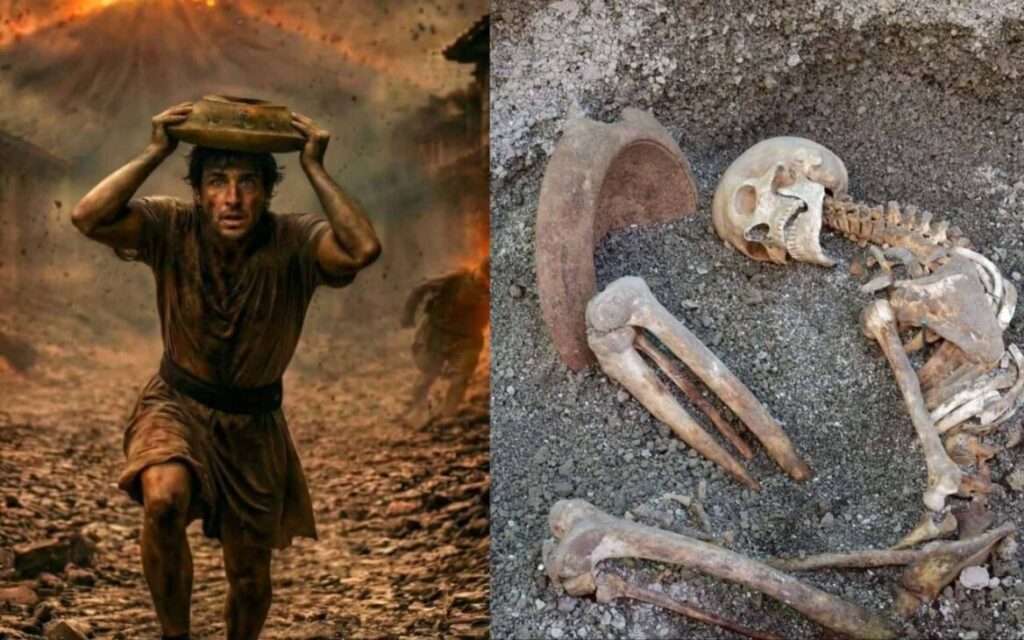
The ancient Roman city of Pompeii has fascinated the world for centuries. Recently, AI digitally reconstructs ancient Pompeii victim face, adding a new layer of insight to our understanding of the city’s tragic history. Buried under volcanic ash by Mount Vesuvius in 79 AD, it remains an extraordinary archaeological time capsule. For generations, its preserved ruins and haunting plaster casts have offered a frozen glimpse into everyday Roman life.
Now, artificial intelligence (AI) is transforming how we study this tragedy. By merging advanced 3D imaging, forensic science, and machine learning, researchers are digitally recreating the faces of people who died nearly 2,000 years ago. These reconstructions do far more than produce striking images—they humanize the past and open entirely new frontiers in archaeology.
Before its sudden destruction, Pompeii was a bustling commercial hub near modern-day Naples, home to roughly 11,000 to 15,000 residents.
The Eruption: In 79 AD, Mount Vesuvius erupted violently, raining ash, pumice, and toxic gases across the region.
The Aftermath: Pyroclastic flows engulfed the city, killing thousands within hours. Nearby towns like Herculaneum and Stabiae suffered the same fate.
The Rediscovery: After remaining buried for 1,700 years, systematic excavations began in the 18th century.
Among the most famous discoveries are the plaster casts of the victims. In the 19th century, archaeologist Giuseppe Fiorelli realized that decomposed bodies left perfect voids in the hardened ash. By injecting plaster into these cavities, he preserved the victims’ final moments in astonishing detail.
Digital facial reconstruction blends anthropology, anatomy, computer science, and art. Instead of relying purely on artistic guesswork, researchers follow a strict, data-driven process:
[1. High-Res Scanning] ➔ [2. Anatomical Analysis] ➔ [3. AI Tissue Prediction] ➔ [4. Digital Rendering]
The skull or plaster cast undergoes advanced imaging—such as CT scans, laser scanning, and photogrammetry—to build a highly detailed 3D digital model.
Forensic anthropologists examine the bone structure to estimate the individual’s age, biological sex, ancestry, and specific muscle attachment points.
Machine learning models trained on thousands of modern human faces estimate soft tissue thickness across the skull. By referencing massive databases of facial anatomy, the software maps out muscle paths and skin contours.
Finally, artists and scientists collaborate to add realistic skin textures, hair patterns, and eye colors. The result balances scientific precision with realistic depth.
One recent project successfully recreated a victim found in the city’s ruins. Using CT scans of a damaged skull, the software generated a lifelike portrait that stunned the public.
Key Features of the Reconstruction:
Natural facial proportions and authentic skin texture.
Historically accurate hairstyle based on Roman records.
A subtle, lifelike emotional expression.
This breakthrough transformed an anonymous skeletal remain into a recognizable human being, bridging a 2,000-year psychological gap.
While the technology is groundbreaking, it does raise important ethical and scientific questions.
Consent and Dignity: Ancient individuals cannot consent to their faces being displayed globally. Critics warn against sensationalizing a historic human tragedy.
Informed Guesswork: AI relies heavily on probability. While skull structure dictates a lot, features like eye color, hair texture, and exact wrinkles still require educated assumptions.
Dataset Bias: If the AI training data lacks diversity, the resulting faces might inadvertently lean toward modern facial trends rather than ancient realities.
Therefore, experts stress that these images should be viewed as scientifically grounded approximations rather than perfect photographs.
The success of the Pompeii project highlights a broader trend. Similar AI tools have already reconstructed the faces of King Richard III, Ötzi the Iceman, and Egyptian mummies.
As artificial intelligence evolves, we may soon see:
Interactive historical avatars.
Virtual reality environments populated by AI residents speaking reconstructed Latin.
Automated digital restoration of crumbling ruins.
Through AI reconstruction, the victims of Mount Vesuvius are no longer just anonymous shapes trapped in plaster. They are restored to our collective memory as real people who lived, worked, and loved. This technology proves that looking forward into the future of tech is often our best tool for looking back into our shared human past.