

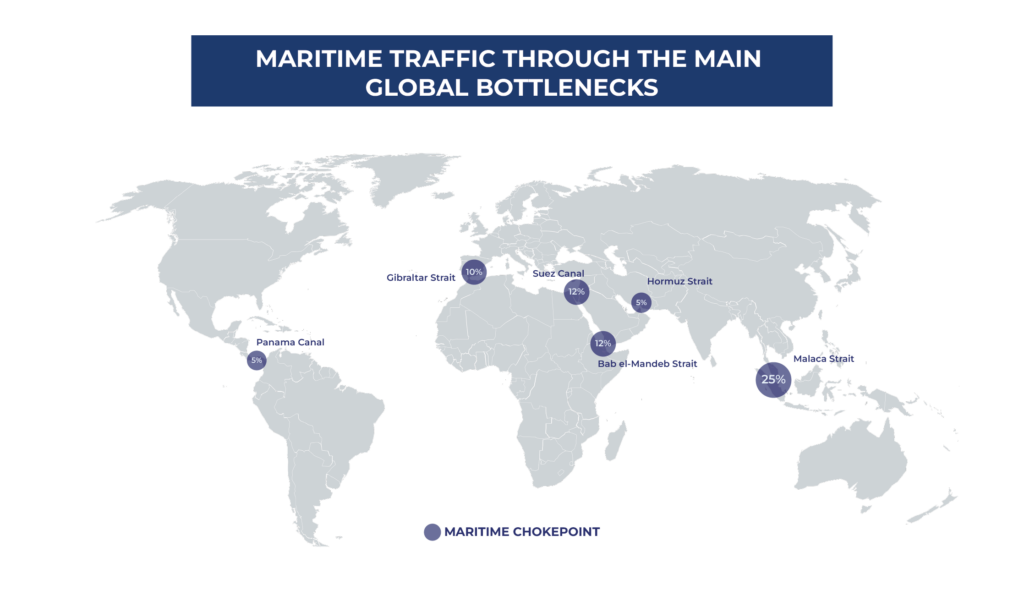
The Strait of Hormuz is one of the most strategically important maritime chokepoints in the world. In fact, understanding the Global Trade Risks Through the Strait of Hormuz Chokepoint is essential for anyone concerned with international commerce today. Located between Iran and Oman, this narrow waterway connects the Persian Gulf to the Arabian Sea and the broader Indian Ocean. Despite its relatively small geographic size, the strait plays an outsized role in global energy security, international trade, and geopolitical stability.
Every day, millions of barrels of crude oil, liquefied natural gas (LNG), refined petroleum products, and commercial goods pass through the Strait of Hormuz. According to data from the U.S. Energy Information Administration (EIA), approximately 20 million barrels of oil per day transit the strait, representing around one-fifth of global petroleum liquids consumption. ([eia.gov](https://www.eia.gov/todayinenergy/detail.php?id=61022&utm_source=chatgpt.com))
Because of this immense strategic importance, any disruption in the Strait of Hormuz immediately sends shockwaves through global markets. Tensions involving Iran, the United States, Gulf Arab states, Israel, and international naval coalitions have repeatedly raised fears about potential blockades, attacks on shipping, and military escalation.
In recent years, growing geopolitical rivalries, regional conflicts, drone warfare, sanctions, and attacks on commercial vessels have intensified concerns about the vulnerability of global trade routes passing through the strait. The risks are not limited to energy markets alone. Supply chains, shipping insurance costs, food prices, industrial manufacturing, and financial markets are all deeply connected to the uninterrupted flow of commerce through this critical corridor.
This article explores the global trade risks associated with the Strait of Hormuz chokepoint, examining its strategic significance, historical crises, geopolitical tensions, economic implications, security challenges, and future outlook.
The Strait of Hormuz lies between Iran to the north and Oman and the United Arab Emirates to the south. At its narrowest point, the strait is only about 21 miles wide, with shipping lanes in each direction measuring roughly two miles wide. ([britannica.com](https://www.britannica.com/place/Strait-of-Hormuz?utm_source=chatgpt.com))
This narrowness creates a natural bottleneck for maritime traffic. Any military conflict, accident, sabotage operation, or obstruction could significantly disrupt global shipping.
The strait serves as the primary export route for major oil-producing nations including:
The Strait of Hormuz is particularly crucial for global energy markets.
Key energy statistics include:
Countries most dependent on Hormuz energy flows include:
This dependence makes the strait not merely a regional issue but a central pillar of global economic stability.
Maritime chokepoints are narrow passages that concentrate shipping traffic into confined areas. Because trade cannot easily bypass these routes, disruptions can create massive economic consequences.
The world has several major chokepoints, including:
Among these, Hormuz is arguably the most critical for energy markets.
One major risk factor is the lack of sufficient alternative export routes.
Although some Gulf states have developed bypass pipelines, these alternatives cannot fully replace Hormuz capacity.
Examples include:
However, these routes remain limited compared to the enormous daily volume moving through Hormuz.
Analysts estimate that only a fraction of Gulf oil exports could bypass the strait during a major disruption. ([csis.org](https://www.csis.org/analysis/strait-hormuz-and-global-energy-market?utm_source=chatgpt.com))
One of the most dangerous periods in the Strait of Hormuz occurred during the Iran-Iraq War.
Between 1984 and 1988, both Iran and Iraq targeted oil tankers and commercial shipping in what became known as the “Tanker War.” Hundreds of vessels were attacked.
The conflict prompted international naval intervention, including U.S. escort operations for Kuwaiti tankers.
This period demonstrated how quickly regional conflict could threaten global energy security.
Over the past two decades, tensions between Iran and the United States have repeatedly increased risks in the strait.
Major flashpoints include:
Iran has repeatedly warned that severe sanctions or military actions could lead to disruption of shipping traffic.
In 2019, several oil tankers were attacked near the Strait of Hormuz and Gulf of Oman.
The incidents significantly increased insurance costs, raised fears of broader conflict, and triggered heightened military deployments by Western powers.
The attacks highlighted vulnerabilities in global shipping infrastructure and demonstrated how relatively small incidents can destabilize markets.
Iran and Western powers have periodically seized commercial vessels amid escalating disputes.
Such incidents increase uncertainty for global shipping companies and contribute to rising freight and insurance costs.
The most immediate economic consequence of any disruption in the Strait of Hormuz is oil price volatility.
Even the threat of military escalation often causes energy prices to spike.
Potential consequences of prolonged disruption include:
Energy markets react rapidly to geopolitical uncertainty because supply disruptions can affect global inventories within days.
Qatar, one of the world’s largest LNG exporters, relies heavily on the Strait of Hormuz.
Disruptions could severely impact:
Following Europe’s efforts to reduce dependence on Russian gas after the Ukraine conflict, Gulf LNG has become even more strategically important.
Security risks in Hormuz significantly influence marine insurance premiums.
When tensions rise:
These costs ultimately affect consumers worldwide through higher prices on imported goods and energy.
Modern supply chains depend heavily on predictable maritime transportation.
Disruptions in Hormuz could affect industries including:
Because energy underpins nearly all industrial activity, sustained instability would ripple across the global economy.
Iran occupies the northern side of the strait, giving it enormous strategic leverage.
The country has invested heavily in asymmetric naval warfare capabilities, including:
Military analysts believe Iran could significantly disrupt shipping even if it could not fully close the strait permanently.
The United States maintains a strong naval presence in the Persian Gulf to ensure freedom of navigation.
The U.S. Fifth Fleet, headquartered in Bahrain, regularly patrols the region alongside allied forces.
International naval coalitions conduct operations aimed at:
However, heavy military presence also increases the risk of accidental escalation.
Broader Middle Eastern rivalries contribute significantly to instability.
Key tensions involve:
Regional conflicts in Yemen, Iraq, Syria, and Lebanon often intersect with Hormuz security concerns.
China is one of the largest importers of Gulf oil.
A substantial portion of Chinese energy imports pass through the Strait of Hormuz.
This dependence makes China increasingly concerned about maritime security and energy diversification.
China has responded through:
Other Asian economies also rely heavily on Gulf energy supplies.
Japan and South Korea import significant volumes of crude oil and LNG from Gulf producers, making Hormuz stability essential for their economic security.
India’s growing energy demand similarly increases its exposure to disruptions.
Military conflict or tanker accidents in Hormuz could trigger catastrophic environmental consequences.
Potential risks include:
The Persian Gulf is particularly vulnerable because of its relatively shallow waters and limited water exchange.
The global transition toward renewable energy may gradually reduce dependence on Hormuz oil flows over time.
However, analysts note that fossil fuels will likely remain central to the global economy for decades.
Until renewable infrastructure expands significantly, Hormuz will continue serving as a critical artery for global energy trade.
A short-term disruption lasting several days or weeks could still cause major market reactions.
Possible impacts include:
A complete closure of the Strait of Hormuz would represent one of the most severe geopolitical shocks in modern history.
Potential consequences include:
Most experts believe a prolonged full closure is unlikely because it would harm Iran economically as well. However, even temporary disruption could create enormous damage.
Many countries maintain strategic oil reserves to mitigate supply disruptions.
The United States, China, Japan, and European nations all maintain emergency reserves that can be released during crises.
However, reserves provide only temporary relief.
Countries increasingly pursue diversification to reduce Hormuz dependence.
Strategies include:
International coalitions continue investing in maritime security operations.
Efforts focus on:
Despite energy transition efforts, the Strait of Hormuz will likely remain strategically essential for decades.
Growing Asian energy demand and ongoing fossil fuel reliance ensure continued significance.
Future threats may involve:
These technologies could make maritime security even more complex.
Long-term stability ultimately depends on diplomatic engagement and regional de-escalation.
Efforts to reduce tensions between Iran, Gulf Arab states, and Western powers remain crucial for protecting global trade.
The Strait of Hormuz remains one of the most critical and vulnerable arteries of the global economy. Its strategic location, narrow geography, and central role in energy transportation make it a focal point of geopolitical competition and economic risk.
As global trade and energy systems become increasingly interconnected, disruptions in Hormuz can rapidly affect oil prices, inflation, shipping costs, supply chains, and financial markets worldwide. Historical incidents have repeatedly demonstrated how quickly regional tensions can escalate into global economic concerns.
While countries continue investing in energy diversification, alternative pipelines, and maritime security, the world remains deeply dependent on uninterrupted trade flows through the strait. The rise of geopolitical rivalries, asymmetric warfare, cyber threats, and drone technologies further complicates the security environment.
Ultimately, maintaining stability in the Strait of Hormuz requires a combination of military deterrence, diplomatic engagement, international cooperation, and long-term energy transition strategies. The stakes are enormous — not only for the Middle East but for the entire global economy.
In an era defined by geopolitical uncertainty and fragile supply chains, the Strait of Hormuz continues to symbolize both the power and vulnerability of global trade interdependence.