

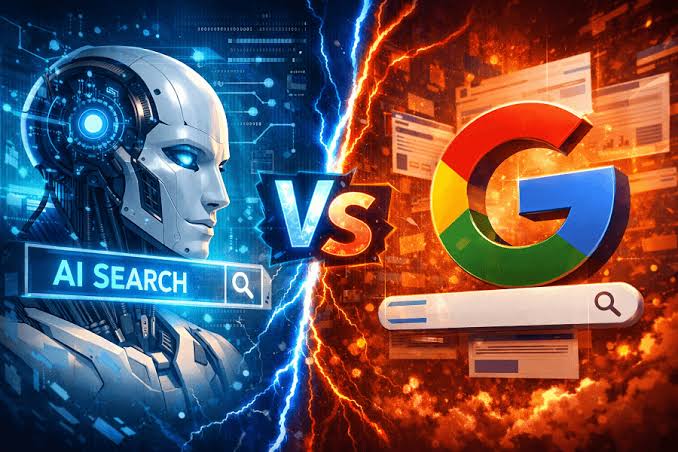
AI-Powered Search Engines Changing Internet Browsing Forever… The internet has undergone multiple revolutions since its creation, from static web pages to dynamic social platforms and mobile-first experiences. Today, another transformative shift is taking place: the rise of AI-powered search engines. Unlike traditional search engines that primarily present users with a list of links, AI-driven search platforms generate direct answers, summarize complex information, personalize recommendations, and assist users in completing tasks with remarkable speed and accuracy.
This technological evolution is changing not only how people search for information but also how businesses create content, how students learn, how professionals conduct research, and how consumers make purchasing decisions. As generative artificial intelligence continues to improve, internet browsing is becoming more conversational, contextual, and efficient than ever before.
AI-powered search engines combine traditional search indexing with advanced artificial intelligence technologies such as natural language processing (NLP), machine learning, large language models (LLMs), and semantic search. Instead of relying solely on keyword matching, these systems attempt to understand the intent behind a user’s query and generate comprehensive responses.
Modern AI search platforms can:
This represents a major departure from traditional web searching, where users often had to open numerous websites before finding the information they needed.
Search engines have evolved dramatically over the last three decades.
Early search engines relied on simple keyword matching. Results were often inconsistent, and users had to carefully choose search terms to obtain relevant information.
Google revolutionized internet search by introducing PageRank, an algorithm that evaluated the authority and popularity of web pages through backlinks. Over time, ranking factors expanded to include:
This significantly improved search accuracy but still required users to browse multiple websites.
Today’s AI-powered search engines focus on understanding language rather than merely matching keywords. Instead of displaying ten blue links, they can generate complete answers, explain concepts, and even help users perform tasks without leaving the search interface.
Artificial intelligence enhances nearly every aspect of the search experience.
Users no longer need to craft perfect search queries. AI understands conversational questions such as:
This creates a much more intuitive experience.
Semantic search focuses on meaning instead of exact keywords. For example, a search for “ways to reduce electricity bills” may return content discussing energy efficiency, insulation, smart thermostats, and renewable energy without requiring those exact words in the query.
AI remembers previous questions within a conversation, allowing users to ask follow-up questions naturally without repeating context.
Several technology companies are investing heavily in AI-enhanced search experiences.
Each platform approaches AI search differently, but all aim to reduce the effort required to find trustworthy information.
Instead of opening ten browser tabs, users often receive summarized answers within seconds.
Professionals can quickly:
AI systems increasingly understand user preferences and provide tailored recommendations for shopping, entertainment, education, and travel.
Students now have access to interactive tutors capable of explaining difficult subjects in multiple ways.
Instead of reading lengthy articles, learners can request:
Educational accessibility has improved significantly because AI can adapt explanations to different learning styles.
Companies must rethink digital marketing strategies as AI changes how users discover information.
Traditional SEO focused on ranking web pages. AI search shifts emphasis toward creating authoritative, trustworthy, and well-structured content that AI systems can understand and cite.
Successful businesses increasingly prioritize:
AI search technology also powers customer service chatbots capable of answering questions instantly around the clock.
Medical professionals often need to review thousands of research papers. AI-powered search tools can summarize scientific literature, identify key findings, and accelerate evidence gathering.
Researchers can compare treatments, locate recent studies, and identify patterns much faster than traditional manual searching. Although human verification remains essential, AI significantly reduces research time.
Software developers increasingly rely on AI-assisted search for coding documentation, debugging assistance, API explanations, and example implementations.
Rather than browsing multiple documentation websites, developers can receive concise explanations with working examples, improving productivity and reducing development time.
Large language models form the foundation of many AI-powered search experiences.
These models are trained on vast amounts of text and learn statistical relationships between words, concepts, and ideas. As a result, they can:
Continuous improvements in these models are making AI search increasingly accurate and useful.
Several industry trends demonstrate the growing importance of AI-powered search:
These trends suggest that AI search is becoming a fundamental component of the modern internet ecosystem.
AI-generated answers may occasionally contain inaccuracies or outdated information. Users should verify important facts using reliable sources, particularly in areas such as healthcare, law, and finance.
Publishers seek fair recognition and traffic when their content contributes to AI-generated answers. Balancing user convenience with sustainable publishing models remains an ongoing challenge.
Conversational AI systems often process large amounts of user input. Organizations must implement strong privacy protections and transparent data handling practices.
AI models may reflect biases present in their training data. Continuous evaluation and responsible development practices are necessary to improve fairness.
Content creators now optimize articles not only for human readers but also for AI systems that summarize and interpret information.
Effective content increasingly emphasizes:
High-quality content remains valuable because AI systems rely on authoritative information to generate useful responses.
Over the next decade, browsing may become significantly more interactive. Instead of navigating dozens of websites, users may collaborate with AI assistants capable of performing research, planning trips, comparing products, scheduling appointments, and completing complex workflows.
Future developments may include:
Rather than replacing traditional websites entirely, AI is likely to complement them by making information easier to discover and understand.
To maximize benefits while minimizing risks, users should adopt responsible search habits.
AI-powered search engines represent one of the most significant transformations in the history of the internet. By combining advanced language understanding, machine learning, and conversational interfaces, these systems are redefining how people discover, evaluate, and interact with information online. They enable faster research, improved productivity, personalized assistance, and more intuitive browsing experiences across education, business, healthcare, software development, and countless other fields.
Despite challenges related to accuracy, privacy, bias, and source attribution, the overall trajectory is clear: AI will continue to reshape the way people navigate the digital world. Success in this new era will depend not only on technological innovation but also on responsible development, transparent practices, and informed users who combine AI-generated insights with critical thinking. As these technologies mature, AI-powered search engines are poised to become indispensable companions for internet users, fundamentally changing online browsing for generations to come.