

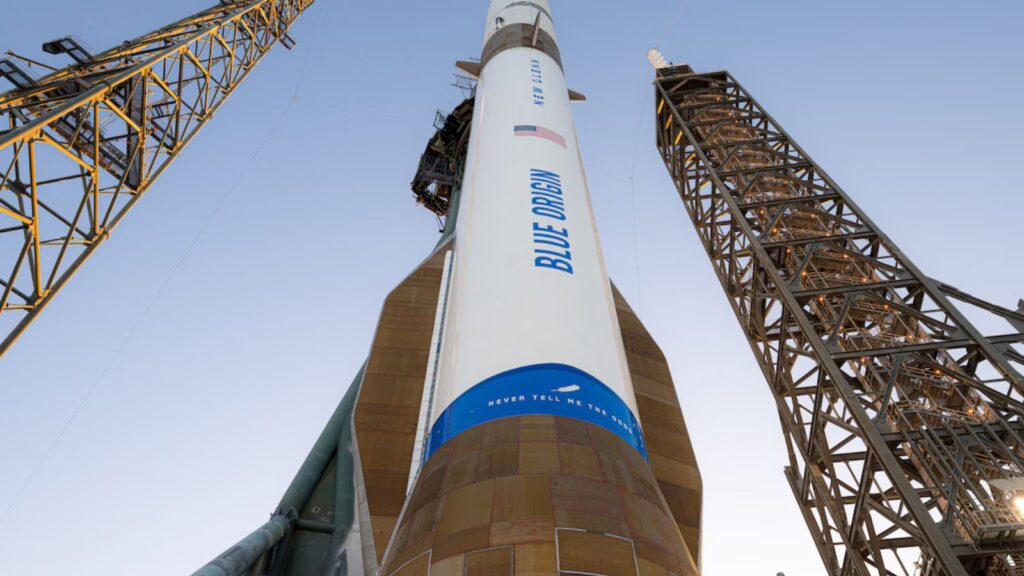
The commercial space industry reached a significant milestone when Blue Origin successfully reused a New Glenn rocket booster for the first time. The achievement marked a major step forward for Jeff Bezos’ space company as it seeks to compete in the increasingly competitive orbital launch market and challenge the dominance of reusable rocket systems pioneered by other industry leaders.
Reusable rocket technology has transformed the economics of spaceflight by reducing launch costs, increasing launch frequency, and making space more accessible for governments, scientific institutions, and commercial organizations. Blue Origin’s successful reuse of a New Glenn first-stage booster demonstrates that the company is making meaningful progress toward its long-term vision of lowering the cost of access to space.
Although the mission encountered challenges with its payload delivery, the successful reflighting and recovery of the booster represented a major technological achievement. The event has significant implications not only for Blue Origin but also for the future of commercial space transportation, satellite deployment, lunar exploration, and the broader space economy.
For decades, rockets were largely disposable machines. After launching payloads into orbit, expensive rocket stages were typically discarded into oceans or allowed to burn up in the atmosphere.
This approach made spaceflight extraordinarily expensive because a new rocket had to be built for nearly every mission.
Reusable rocket technology changed this paradigm by enabling portions of launch vehicles to return safely to Earth and fly again.
The benefits include:
Blue Origin has long pursued reusable launch systems, beginning with its suborbital New Shepard program before expanding into orbital-class vehicles with New Glenn.
New Glenn is Blue Origin’s heavy-lift orbital launch vehicle designed to transport satellites, scientific payloads, national security missions, and future lunar exploration hardware.
The rocket is named after astronaut John Glenn, the first American to orbit Earth.
Standing approximately 98 meters (321 feet) tall, New Glenn is among the largest rockets currently operating in the commercial launch sector.
The vehicle has been under development for more than a decade and represents one of Blue Origin’s most ambitious engineering projects.
Blue Origin achieved the first successful reuse of a New Glenn booster during the rocket’s third flight in April 2026. The mission utilized a previously flown first-stage booster that had already completed an earlier launch and recovery operation. The booster successfully launched the rocket and later returned to Earth, landing on a recovery vessel in the Atlantic Ocean.
The booster used during the mission had previously flown on an earlier New Glenn launch, making this the company’s first demonstration of orbital booster reusability with the New Glenn system. After launch, the booster separated from the upper stage and successfully landed on Blue Origin’s ocean-going recovery platform.
This accomplishment represented a major validation of the rocket’s reusable design philosophy and demonstrated Blue Origin’s ability to recover, refurbish, and fly a heavy-lift booster multiple times.
The successful reuse of a New Glenn booster is far more significant than a simple landing demonstration. It directly impacts the economics and operational efficiency of spaceflight.
The first stage is often the most expensive component of a launch vehicle. Reusing this hardware allows companies to spread manufacturing costs across multiple missions.
Potential benefits include:
As launch providers reduce costs, satellite operators and scientific organizations gain greater opportunities to deploy missions.
Reusable boosters enable more frequent launches because companies can refurbish existing hardware instead of building entirely new vehicles for every mission.
This approach helps support growing demand from:
Higher launch frequency is becoming increasingly important as the global space economy expands.
While the booster reuse objective was successful, the mission was not a complete success from a payload perspective.
The New Glenn upper stage experienced issues that resulted in a communications satellite being placed into an orbit lower than intended. The payload, operated by AST SpaceMobile, was unable to achieve its planned mission profile and was ultimately lost.
Blue Origin later reported that an off-nominal thermal condition affected upper-stage engine performance, contributing to the payload delivery failure. Regulatory authorities subsequently cleared the vehicle to return to flight after corrective measures were implemented.
Despite the setback, industry observers widely viewed the booster reuse achievement as a major technological milestone.
The success of New Glenn’s reusable booster naturally invites comparisons with other reusable launch systems.
New Glenn offers several capabilities that position it as a strong competitor in the launch market.
Industry analysts view reusable heavy-lift systems as essential for future space infrastructure development, including lunar missions and large satellite constellations.
While booster recovery is important, customers ultimately evaluate launch providers based on mission success rates.
Future New Glenn missions will need to demonstrate:
Achieving all four objectives consistently is critical for long-term commercial success.
Historically, launch costs represented one of the largest barriers to space access. Traditional expendable rockets required substantial manufacturing efforts for every flight.
Reusable systems have fundamentally changed industry economics.
Key economic advantages include:
Blue Origin’s successful New Glenn booster reuse is an important step toward realizing these economic benefits at scale.
Recovering and reusing a rocket booster is one of the most difficult engineering tasks in aerospace.
Rocket boosters must survive:
Each mission subjects the vehicle to enormous stress, making reusability a significant engineering challenge.
Following stage separation, the booster must:
The successful landing of a previously flown New Glenn booster demonstrates the maturity of Blue Origin’s guidance, navigation, and control systems.
New Glenn plays an important role in Blue Origin’s broader space ambitions, including support for future lunar exploration initiatives.
NASA has selected Blue Origin for several lunar-related projects, including missions associated with lunar infrastructure and cargo delivery programs. Continued progress with reusable launch systems strengthens the company’s ability to support these initiatives.
Reliable heavy-lift transportation will be essential for:
The maturation of New Glenn could play a critical role in future lunar operations.
One of the most important markets for New Glenn is satellite deployment.
Demand for launch services continues to rise due to the rapid growth of broadband satellite networks and Earth observation systems.
Potential customers include:
Blue Origin has stated plans to support large-scale satellite deployment efforts, including launches connected to Amazon-backed satellite initiatives.
Although the first booster reuse was a major success, New Glenn subsequently experienced another challenge.
In May 2026, a New Glenn vehicle exploded during a hot-fire test at Cape Canaveral, damaging portions of the launch infrastructure. Despite the dramatic nature of the incident, Blue Origin reported that several key facilities remained intact and stated its intention to return New Glenn to flight operations before the end of the year.
The event highlighted the realities of rocket development, where significant progress is often accompanied by technical setbacks.
The New Glenn booster reuse mission offers several important lessons for the aerospace industry.
Many of the world’s most successful aerospace programs have evolved through repeated testing, learning, and refinement.
Looking ahead, Blue Origin plans to increase the flight rate of New Glenn while expanding its role in commercial, scientific, and government missions.
Future objectives include:
Achieving these goals would establish New Glenn as one of the world’s premier heavy-lift launch systems.
The successful reuse of a New Glenn booster represents more than a company milestone. It reflects a broader transformation occurring across the global space sector.
Reusable rockets are enabling:
As more companies adopt reusable technologies, competition is expected to drive innovation and further reduce the cost of space transportation.
Blue Origin’s successful reuse of a New Glenn rocket booster marks a historic achievement in the evolution of commercial spaceflight. By flying and recovering a previously used first-stage booster, the company demonstrated a critical capability that is essential for reducing launch costs, increasing operational efficiency, and supporting future large-scale space activities. Although the mission encountered challenges with payload delivery, the booster reuse milestone validated years of engineering development and positioned New Glenn as a serious contender in the reusable launch market.
The accomplishment carries important implications for satellite deployment, scientific research, lunar exploration, and the future growth of the global space economy. As Blue Origin continues refining the New Glenn system and expanding its launch capabilities, the successful first booster reuse may be remembered as a defining moment in the company’s journey toward making space access more affordable, reliable, and sustainable.