

The modern world is changing faster than ever. Today, we face a mix of big changes: political drama, economic ups and downs, new technology, climate change, and shifting social values. This landscape creates a lot of new challenges, but it also brings exciting opportunities for nations, businesses, and everyday people. The current global situation and its impact on society today can be seen across all these areas of life.
Because of globalization, our world is deeply connected. An event that happens in one country can quickly create a chain reaction that affects people thousands of miles away.
The COVID-19 pandemic showed us exactly how fragile our healthcare systems, supply chains, and jobs really are. At the same time, massive tech upgrades have completely changed the way we talk, learn, work, and live.
To get ready for tomorrow, we need to understand these shifts. This article breaks down the biggest global trends right now, how they hit different industries, and what to expect in the coming years.
The world economy is under a lot of stress right now. High prices, heavy debt, and regional wars are making it hard to fully bounce back from the pandemic.
The most urgent issue for families today is inflation (the steady rise in prices). Everything from food and electricity to rent and healthcare costs a lot more than it used to. This means a regular paycheck doesn’t buy as much as it did a few years ago.
Many countries are seeing the highest price spikes in decades. The main causes include:
Shipping delays and broken factory chains
Global energy shortages that drive up power bills
Wars and conflicts that cut off access to resources
Labor shortages in key industries
High demand as people started buying again after pandemic lockdowns
As basic bills go up, middle-class and low-income families are feeling the pinch. People are forced to focus only on what they absolutely need while cutting back on fun or extra spending.
Governments around the world borrowed massive amounts of money during the pandemic to fund stimulus checks and survival programs. Now, many developing nations owe so much money that their economies are on thin ice.
Why High Government Debt Hurts Everyone:
Governments have less money to spend on schools, roads, and hospitals.
Taxes usually go up for citizens and local businesses.
Local currencies lose value, making imported goods even pricier.
Poverty risks shoot up for the most vulnerable groups.
International banks keep warning that this mountain of debt is not sustainable for the long run.
The way we work is shifting rapidly due to automation, remote setups, and artificial intelligence. While some industries are desperate for workers, others are cutting jobs entirely.
The Biggest Workforce Trends:
Working from home (or a mix of home and office) is now completely normal.
The freelance and gig economies (like driving or contracting) are booming.
Machines and software are taking over repetitive, manual tasks.
Companies are hunting for workers with strong digital skills.
Workers are prioritizing their mental health and family time over long hours.
To survive, companies are paying to retrain their current employees so they can handle new tech tools.
Arguments and instability between world leaders are reshaping international relations and hurting the global economy.
Conflicts in different parts of the world are causing terrible human suffering and forcing millions of people to flee their homes. Because our global economy is so connected, a war in one region quickly triggers higher energy prices, food shortages, and broken trade deals worldwide.
How Global Conflicts Affect You:
Energy and gas prices swing wildly from week to week.
Shipments of food and parts get delayed or canceled.
Massive humanitarian crises leave millions of refugees needing aid.
Governments spend more money on defense and military instead of public services.
Hackers launch more dangerous attacks on important computer networks.
Cybersecurity is no longer just an IT issue—it is now a top priority for national safety. Governments, large corporations, and vital utility systems are constantly attacked by criminal gangs and state-funded hackers.
Common Digital Threats:
Ransomware: Software that locks up hospital or school computers until they pay a fee.
Data Breaches: Thieves stealing millions of personal passwords and credit cards.
Fake News: Online disinformation campaigns designed to make people angry and divided.
Infrastructure Attacks: Attempts to shut down power grids or water systems.
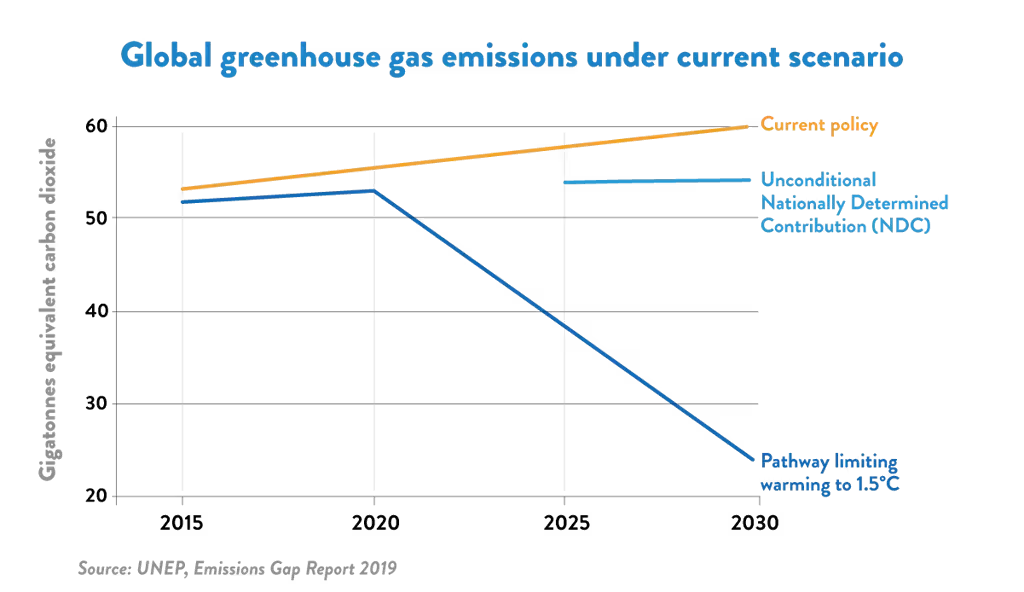
Climate change is one of the biggest tests of our time. Extreme weather, rising temperatures, and pollution are disrupting regular life everywhere.
Floods, forest fires, long droughts, and record-breaking heatwaves are happening more often and getting worse. These events destroy homes and roads, ruin farm crops, crowd hospitals, and cost local communities billions of dollars to clean up.
The Human Cost of Climate Change:
Serious shortages of fresh food and clean water
People being forced to move away from ruined lands
New health risks from extreme heat and pollution
Financial ruin for coastal towns and farming communities
To protect the planet, countries are moving away from fossil fuels (like oil and coal) and investing heavily in clean energy. Solar panels, wind turbines, water power, and green hydrogen are leading the charge.
The Perks of the Green Transition:
Much lower pollution levels and cleaner air
Countries don’t have to rely on foreign nations for oil and gas
New, steady economic growth
Millions of new jobs building and running clean energy systems
Smart software and digital tools are rapidly changing how we live, work, and learn.
Artificial intelligence is moving incredibly fast. Today, AI programs help doctors find diseases, manage money, automate factories, and even write text or create art in seconds.
| The Bright Side of AI | The Worries & Risks |
|---|---|
| Helps workers get things done faster | Could replace certain human jobs |
| Spots health issues early in patients | Creates new privacy risks with personal data |
| Runs complex factory work smoothly | Can pass on human biases and prejudices |
| Creates personalized shopping and learning | Can be used to spread very convincing fake news |
| Speeds up scientific and medical research | Raises tough ethical and legal questions |
The quick rise of these tools has started global debates about how to regulate AI, protect copyrights, and save human jobs.
Social media platforms hold massive power over what we think, how we vote, and how we feel. While the internet makes it easy to learn anything instantly, it has also created heavy challenges:
Fake news and lies spread incredibly fast.
Communities are more divided and argumentative online.
Mental health struggles, especially among teenagers, are rising.
Online bullying and harassment are common problems.
People have a harder time focusing because of constant digital notifications.
The pandemic was a massive wake-up call that showed us what our hospitals do well and where they fail.
The crisis caught us off guard with major shortages of masks, medicine, hospital beds, and nurses. However, it also forced medical tech to improve at lightning speed, leading to:
Telehealth: Seeing your doctor over video calls instead of traveling to an office.
Fast Vaccines: Creating new ways (like mRNA technology) to build safe vaccines quickly.
Digital Trackers: Using apps and smartwatches to watch over patient health at home.
Because of this, governments are now spending much more money to prepare for future health emergencies.
More people are struggling with mental health issues than in the past. This quiet crisis is driven by financial stress, isolation, digital addiction, and feeling burned out at work. Young people, in particular, are reporting very high rates of anxiety and depression.
Even though medicine is getting better, getting good care still depends heavily on how much money you have. Developing countries and poor neighborhoods still do not have enough trained doctors, modern clinics, or affordable medicine.
Schools and universities are changing their teaching styles to match a digital world and a changing job market.
Online classes went from a temporary emergency fix to a permanent option for students of all ages.
The Benefits of Online Classrooms:
Students can learn at their own speed on a flexible schedule.
Anyone with an internet connection can take courses from top global schools.
It lowers the cost of travel and campus fees.
However, this shift has also widened the gap for students who do not have reliable internet or computer devices at home.
To help students get ready for a fast-changing job market, schools are moving away from memorizing facts. Instead, they are teaching:
Critical thinking: Figuring out what information is actually true and useful.
Digital literacy: Understanding how to use data and modern software.
Problem-solving: Figuring out answers to complex, real-world issues.
Creativity: Coming up with original ideas.
Adaptability: Staying calm and flexible when things change.
The gap between different social groups remains a huge challenge, making it harder for people to get fair pay, good healthcare, and quality schooling.
The division between the super-rich and low-income families is growing wider. This happens because of a few main reasons: elite schools cost too much, automation is replacing entry-level jobs, housing prices are out of control, and tax systems often favor big businesses. When this gap gets too wide, it leads to anger and public protests.
Thanks to internet activism, movements for social justice have grown incredibly strong. People around the world are pushing for:
Fair treatment for all races and cultures
Safe conditions and fair wages for workers
Better environment protection for poor neighborhoods hit hardest by pollution
Where people live is changing because of wars, climate challenges, job searches, and a shifting global age gap.
Millions of people are forced to leave their home nations to escape war, political danger, or natural disasters. Towns and countries that welcome them sometimes struggle to find enough affordable housing, open jobs, and healthcare slots for everyone right away.
On the positive side, welcoming immigrants brings fresh energy, fills job vacancies, and adds wonderful cultural diversity to local communities.
At the same time, many wealthy countries are dealing with a different issue: their populations are getting older while birth rates are dropping. This causes unique problems:
Not enough young workers to fill open jobs
Massive strain on retirement and social security budgets
A huge demand for senior healthcare and nursing care
Slower economic growth because fewer people are working
To fix this, governments are looking at smoother immigration rules and using smart machines to fill the gaps.
The classic 9-to-5 office setup has changed forever. A mix of new software and a demand for better work-life balance has rewritten the rules of employment.
What started as a pandemic rule has become a permanent perk that workers love.
The Pros: You get great personal flexibility, skip the daily traffic commute, can apply for jobs anywhere in the world, and have more time for family.
The Cons: It is harder to build real friendships with coworkers, communication can slow down, and home internet networks are easier for hackers to target.
Smart machines are taking over dull, predictable, and repetitive tasks. This is happening fastest in factories, customer service call centers, delivery driving, retail checkouts, and warehouses. Experts warn that constant, lifelong learning is the only way for workers to avoid losing their jobs to automation.
Recent global events proved that our international shipping and supply networks are much more fragile than we thought.
When factories shut down or cargo ships got stuck in ports, businesses realized that relying on a single foreign country for all their manufacturing is a dangerous plan.
Because of this, companies are changing how they stock up on parts. Instead of keeping inventory low to save cash, they are buying from multiple suppliers, tracking shipments with smart software, and moving manufacturing facilities closer to home.
To protect their local economies, many countries are cutting back on foreign dependencies for vital items like medicine, computer chips, and military parts. This has started new business trends:
Nearshoring: Moving your factories to a neighboring country that is close by.
Onshoring: Rebuilding manufacturing plants inside your own home country.
Friendshoring: Doing business only with countries that share the same political values.
Caring for the environment is no longer just a nice public relations goal—it is now a business requirement demanded by shoppers, investors, and governments.
Environmental, Social, and Governance (ESG) standards now dictate where big investment money goes. Companies are working hard to:
Cut down their carbon footprints to hit net-zero targets
Design eco-friendly products that can be recycled easily
Use 100% clean power for their offices and factories
Ensure fair treatment for all workers in their supply chains
Spend money to support local communities
Shoppers—especially younger generations—are choosing to buy from brands that care about the earth, while walking away from companies that just pretend to be green.
The biggest problems we face today—like pandemics, climate change, hackers, and economic crashes—do not stop at borders. No single country can solve them alone; they require global teamwork.
Groups like the United Nations and the World Health Organization are vital for organizing these efforts. The world needs to cooperate on:
Watching out for new viruses and stopping global health outbreaks
Setting shared climate targets and cutting pollution
Making global rules to stop cybercriminals
Sending quick food and medical aid to disaster zones
However, when world leaders focus only on their own national interests or get into political rivalries, this vital teamwork slows down.
Young people today have amazing tech tools at their fingertips, but they also carry a heavy financial and mental burden.
The Main Stresses for Young Adults:
Housing Costs: Rent and home prices are so high that buying a house feels impossible.
Student Loans: Starting a career with massive debt in an unpredictable job market.
Job Instability: Working freelance or contract gigs without classic health benefits.
Eco-Anxiety: Constantly worrying about the future of a planet in a climate crisis.
Even with these hurdles, young people are leading the way in creating new tech businesses and pushing for positive social changes.
The speed of global change proves that being flexible is the most important skill for individuals, businesses, and governments. To do well in tomorrow’s job market, workers need to build a versatile skillset:
[Future Skillset] ➔ Tech Skills + People Skills + Smart Thinking + Continuous Learning
Communities and countries that welcome new ideas, fight inequality, and truly protect the environment will be the ones that succeed in the future.
The world today is a mix of tough challenges and incredible new opportunities. While economic shifts, political tension, and climate change bring real risks, our breakthroughs in AI, green energy, and medicine give us powerful ways to fix these problems.
Getting through these fast changes requires resilience, teamwork, flexibility, and good leadership. Governments, companies, and everyday citizens all have a role to play. By making smart choices together, we can turn this period of massive change into a safer, fairer, and more sustainable future for everyone.