

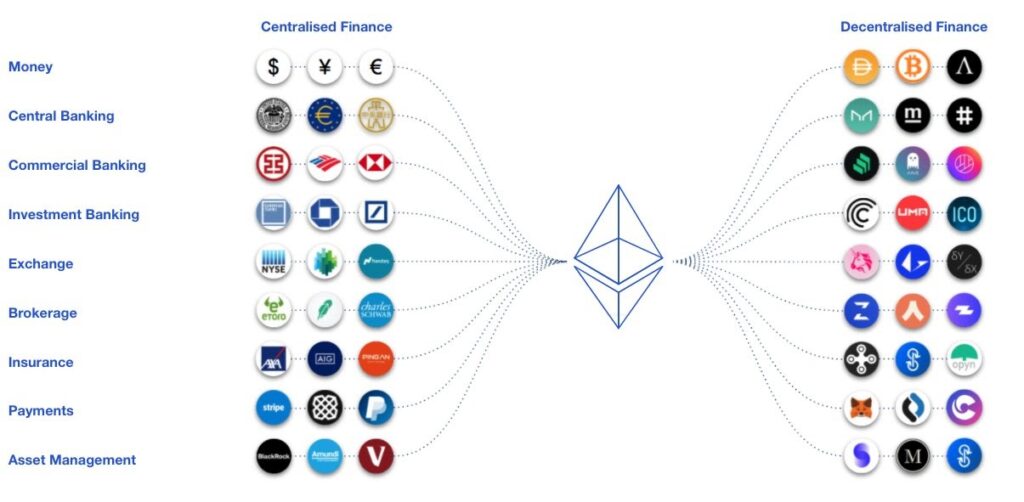
Decentralized finance, commonly known as DeFi, represents one of the most disruptive innovations in the financial sector. Built on blockchain networks, DeFi eliminates the need for traditional intermediaries such as banks, brokers, and financial institutions, enabling peer-to-peer financial transactions in a transparent, secure, and programmable environment. There has been a rapid rise in Decentralized Finance Applications on Blockchain Networks, changing how financial services are accessed and utilised.
Over the past few years, DeFi has grown from a niche experiment into a multi-billion-dollar ecosystem. It encompasses a wide range of applications, including lending platforms, decentralized exchanges, stablecoins, insurance protocols, and more. These applications leverage blockchain technology to provide open, permissionless access to financial services.
This article explores the core principles of decentralized finance, its applications across blockchain networks, real-world case studies, benefits, risks, and the future outlook of this rapidly evolving sector.
Decentralized finance refers to financial services that operate on blockchain networks without centralized control. Instead of relying on institutions, DeFi uses smart contracts—self-executing programs stored on a blockchain—to automate transactions and enforce agreements.
Most DeFi applications are built on blockchain platforms like Ethereum, which support programmable smart contracts.
These features make DeFi fundamentally different from traditional financial systems.
Blockchain technology serves as the backbone of DeFi applications. Different networks offer varying levels of scalability, security, and functionality.
Each platform supports a growing ecosystem of DeFi applications tailored to different use cases.
DeFi encompasses a wide range of financial services that replicate or improve upon traditional systems.
Decentralized exchanges allow users to trade cryptocurrencies directly without intermediaries.
Popular DEXs include platforms like Uniswap and SushiSwap.
DeFi lending platforms enable users to lend their assets and earn interest or borrow funds by providing collateral.
Examples include Aave and Compound.
Stablecoins are cryptocurrencies pegged to stable assets such as fiat currencies.
Examples include USDC and DAI.
Yield farming allows users to earn rewards by providing liquidity to DeFi protocols.
Staking involves locking assets to support network operations and earn rewards.
DeFi insurance platforms provide coverage against risks such as smart contract failures.
Uniswap is one of the most successful decentralized exchanges, introducing the concept of automated market makers (AMMs).
Instead of traditional order books, Uniswap uses liquidity pools where users deposit tokens. Prices are determined by mathematical formulas.
This model has inspired numerous other DeFi platforms.
DeFi offers several advantages over traditional financial systems.
Despite its benefits, DeFi also presents significant risks.
Errors in code can lead to exploits and financial losses.
Cryptocurrency prices are highly volatile, affecting DeFi assets.
Governments are still developing frameworks to regulate DeFi.
Sudden withdrawal of funds can destabilize platforms.
Several high-profile DeFi hacks have highlighted the importance of security.
For example, vulnerabilities in smart contracts have led to millions of dollars in losses across various platforms.
Traditional financial institutions are beginning to explore DeFi integration.
This convergence could reshape the global financial ecosystem.
Regulation is a critical factor in the future of DeFi.
Balancing innovation with regulation remains a major challenge.
The future of DeFi is promising, with continued innovation and adoption expected.
As technology evolves, DeFi could become a mainstream component of global finance.
DeFi has the potential to reshape the global financial system.
However, its impact will depend on how challenges are addressed.
Decentralized finance represents a paradigm shift in how financial services are delivered and accessed. By leveraging blockchain technology, DeFi applications provide transparent, accessible, and innovative alternatives to traditional financial systems.
From decentralized exchanges and lending platforms to stablecoins and insurance protocols, DeFi is transforming the financial landscape. While challenges such as security risks and regulatory uncertainty remain, the potential benefits are significant.
As the ecosystem continues to evolve, collaboration between developers, regulators, and institutions will be essential to ensure sustainable growth. With the right balance of innovation and oversight, decentralized finance could play a central role in shaping the future of global finance.