

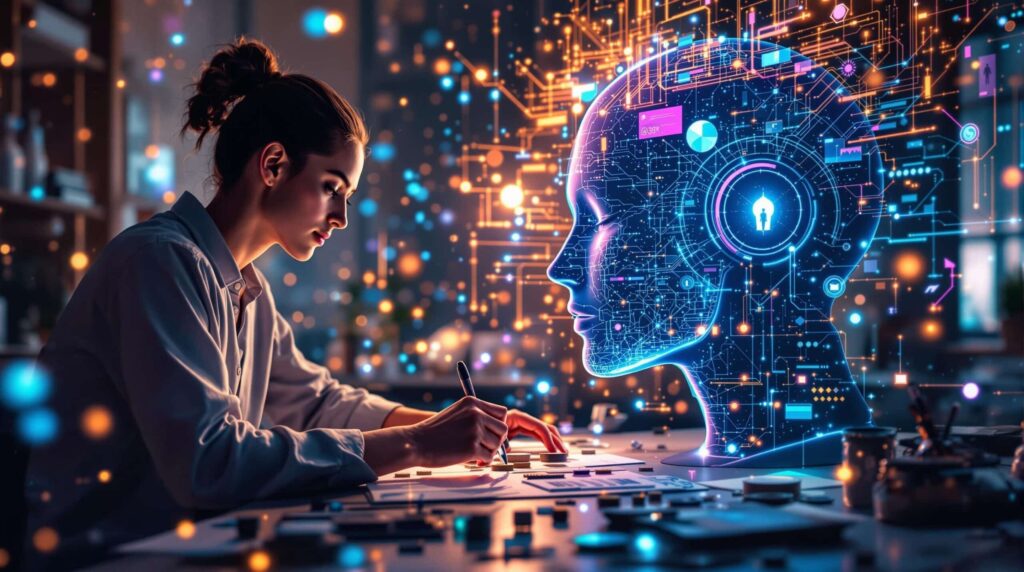
Generative artificial intelligence (AI) is rapidly redefining the boundaries of creativity across industries. Once considered an exclusively human domain, creative work—ranging from writing and visual art to music and film—is now being augmented, and sometimes challenged, by machines capable of producing original content.
With the rise of advanced generative models such as large language models, image generators, and music synthesis tools, industries are witnessing a profound transformation. These technologies are not only accelerating production processes but also reshaping how creativity is conceptualized, valued, and monetized.
This article explores the role of generative AI in creative industries, examining its applications, benefits, risks, ethical implications, and long-term impact on artists, businesses, and society.
Generative AI refers to a class of machine learning models capable of creating new content based on patterns learned from existing data. Unlike traditional AI systems that focus on classification or prediction, generative models produce text, images, audio, and even video.
These systems rely heavily on deep learning techniques, particularly neural networks trained on vast datasets.
The rapid improvement of these technologies has made them accessible to both professionals and everyday users.
Creativity has evolved significantly over the past few decades. From traditional hand-crafted art to digital design tools, each technological advancement has expanded the possibilities for creators.
Generative AI represents the next step in this evolution, enabling machines to participate actively in the creative process.
This progression highlights how technology continually reshapes creative industries.
Generative AI is being used across a wide range of creative fields, enabling new forms of expression and efficiency.
AI-powered tools can generate images, illustrations, and graphic designs based on text prompts or existing styles.
Designers often use these tools as inspiration or to accelerate workflows.
Generative AI is widely used in writing, from journalism to marketing.
While AI can produce large volumes of content quickly, human oversight remains crucial for quality and authenticity.
AI systems can compose music, generate sound effects, and even mimic human voices.
This technology is particularly valuable in gaming and film production.
Generative AI is transforming video production by automating editing and content generation.
These tools reduce production time and costs while expanding creative possibilities.
One of the most prominent uses of generative AI is in advertising. Major brands are leveraging AI to create personalized marketing campaigns at scale.
For example, AI can analyze consumer data and generate tailored advertisements for different audiences, improving engagement and conversion rates.
This demonstrates how AI can enhance both creativity and efficiency in commercial applications.
The integration of generative AI into creative industries has significant economic implications.
According to industry estimates, AI-driven tools could contribute hundreds of billions of dollars to the global economy by increasing productivity and enabling new business models.
However, these benefits are accompanied by concerns about job displacement and income inequality.
Despite its advantages, generative AI raises several ethical and practical challenges.
AI models are often trained on copyrighted material, raising questions about ownership and originality.
Automation of creative tasks may reduce demand for certain roles.
However, new roles are also emerging in AI supervision and creative direction.
Generative AI can create highly realistic but false content, posing risks to society.
AI systems may reflect biases present in training data, leading to unfair or harmful outputs.
Rather than replacing human creativity, generative AI is increasingly seen as a collaborative tool.
Artists and creators can use AI to enhance their work, explore new ideas, and push creative boundaries.
This partnership between humans and machines is redefining what it means to be creative.
Film studios are beginning to use AI for script analysis, casting decisions, and visual effects.
AI tools can predict audience preferences, optimize storylines, and generate realistic visual effects.
This illustrates how AI is becoming an integral part of the filmmaking process.
Governments and organizations are working to establish guidelines for the ethical use of generative AI.
Effective regulation will be crucial to balancing innovation with accountability.
The future of generative AI in creative industries is filled with possibilities.
These trends suggest a future where creativity becomes more accessible and interactive.
As generative AI continues to evolve, it is essential to strike a balance between innovation and ethical responsibility.
Stakeholders—including developers, policymakers, and creators—must work together to ensure that AI benefits society while minimizing risks.
Generative artificial intelligence is reshaping creative industries in profound ways. From visual arts and writing to music and film, AI is enabling new forms of expression, increasing efficiency, and opening up opportunities for innovation.
However, these advancements come with significant challenges, including ethical concerns, intellectual property issues, and potential job displacement. Addressing these challenges requires thoughtful governance, responsible development, and a commitment to ethical principles.
Ultimately, the future of creativity lies in collaboration between humans and machines. By leveraging the strengths of both, society can unlock new levels of artistic expression and innovation while ensuring that creativity remains a deeply human endeavor.