

Edge Computing Technology Supporting Faster AI Applications… Artificial Intelligence (AI) has transformed the way businesses operate, enabling machines to analyze data, make decisions, and automate complex processes. However, as AI applications become more sophisticated, traditional cloud-based architectures often struggle to meet the demands of ultra-low latency, real-time decision-making, bandwidth efficiency, and privacy. This challenge has led to the rapid adoption of edge computing, a computing paradigm that processes data closer to where it is generated rather than sending everything to centralized cloud servers.
Edge computing is revolutionizing AI by allowing intelligent applications to execute faster, respond instantly, and continue functioning even with limited internet connectivity. From autonomous vehicles and smart factories to healthcare monitoring and retail analytics, edge AI is becoming an essential technology for modern digital transformation. This article explores how edge computing supports faster AI applications, its benefits, real-world use cases, technological architecture, challenges, and future trends.
Edge computing is a distributed computing model where computation, storage, and data processing occur near the physical location where data is created. Instead of transmitting every piece of information to a distant cloud data center, edge devices process much of the data locally.
Common edge devices include:
These devices often include AI accelerators capable of running machine learning inference directly on-site.
AI workloads generally consist of two primary stages:
Most edge computing deployments focus on accelerating AI inference because it requires immediate responses with minimal delay.
Cloud computing remains essential for centralized storage, model training, and large-scale analytics. However, relying entirely on the cloud introduces several limitations for real-time AI.
For applications that require decisions within milliseconds, cloud-only processing simply cannot meet performance expectations.
One of the biggest advantages of edge computing is dramatically reduced latency. Since AI processing occurs locally, devices no longer wait for data to travel across the internet to distant servers.
Typical latency comparison:
For autonomous vehicles or industrial robotics, even a delay of a few milliseconds can significantly affect safety and performance.
Modern AI systems generate enormous quantities of information.
Consider a manufacturing plant with thousands of high-resolution cameras continuously monitoring production lines. Uploading every video frame to the cloud would consume enormous bandwidth.
Edge AI solves this problem by analyzing video locally and transmitting only meaningful events, such as:
This significantly lowers network traffic and operational costs.
Many industries handle highly sensitive information.
Keeping AI inference at the edge reduces the amount of sensitive data transmitted over public networks, helping organizations strengthen privacy and regulatory compliance.
Edge AI applications can continue functioning during network disruptions.
Examples include:
Because intelligence resides locally, these systems remain operational even when internet connectivity is unavailable.
A modern edge AI architecture generally includes several interconnected layers.
Acts as an intermediary that aggregates data, performs AI inference, filters unnecessary information, and communicates with cloud services.
Provides additional computational resources for multiple edge devices operating within the same facility.
This hybrid architecture combines the strengths of both cloud and edge computing.
Specialized hardware dramatically improves AI inference speed while reducing power consumption.
5G offers:
These capabilities significantly enhance distributed AI systems.
Lightweight containers allow AI applications to be deployed consistently across different edge devices.
Instead of transferring raw data, devices train AI models locally and share only model updates. This approach enhances privacy while continuously improving AI performance.
Self-driving cars represent one of the most demanding AI applications.
Every second, vehicles collect information from:
These systems generate several terabytes of data daily. Waiting for cloud responses would be unsafe. Instead, onboard edge computers process sensor inputs instantly to:
Industry 4.0 relies heavily on edge AI.
Manufacturing facilities use computer vision systems to inspect products in real time.
Benefits include:
For example, cameras can detect tiny defects on assembly lines within milliseconds, removing faulty products before packaging.
Healthcare organizations increasingly deploy AI-powered edge devices.
These devices analyze patient information immediately, enabling faster diagnosis and treatment without relying on constant cloud connectivity.
Retail stores use edge AI for:
Smart cameras can recognize empty shelves and automatically notify employees to restock products.
Edge AI supports urban infrastructure through intelligent traffic systems.
Applications include:
Instead of uploading continuous video streams, edge systems analyze events locally and transmit only relevant alerts.
Modern farms increasingly rely on AI-powered edge devices.
Local AI enables rapid decisions that improve crop yield while reducing water consumption.
A large manufacturing company installed thousands of vibration and temperature sensors across production equipment.
Previously, all sensor data was transmitted to the cloud for analysis. This resulted in:
After deploying edge AI servers inside the factory:
This demonstrates how local AI processing directly improves operational efficiency.
A nationwide retail chain introduced AI-enabled smart cameras across multiple stores.
The cameras performed local analysis to:
Instead of continuously streaming video to cloud servers, only important events were transmitted.
The retailer experienced:
Industry research consistently indicates rapid adoption of edge computing technologies.
These trends underscore that edge computing is evolving from a niche architecture into a mainstream foundation for AI deployment.
Many edge devices possess far less processing power than cloud servers.
Developers must optimize AI models through techniques such as:
Distributed devices are physically accessible, making them potential targets for:
Strong encryption, secure boot processes, device authentication, and regular software updates are essential for protecting edge infrastructure.
Organizations may need to manage thousands of geographically distributed edge devices.
Centralized monitoring, remote software deployment, and automated lifecycle management become increasingly important.
Battery-operated devices require highly energy-efficient AI models.
Hardware optimization and low-power processors help extend operational lifespan.
The future of AI increasingly depends on distributed intelligence rather than centralized processing alone. Advances in semiconductor technology, specialized AI chips, and ultra-fast communication networks will continue making edge computing more powerful and accessible.
Emerging developments include:
As AI models become more efficient, increasingly complex tasks that once required powerful cloud servers will execute directly on local devices.
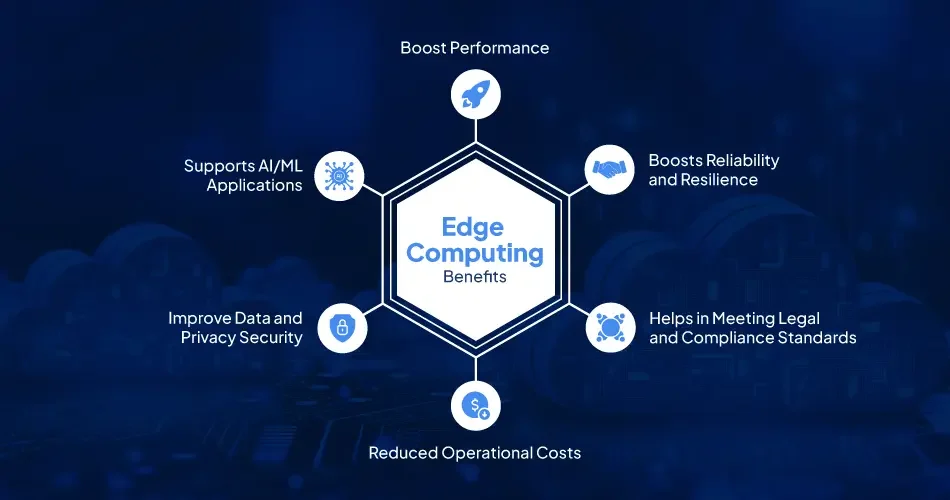
Organizations implementing edge AI can achieve measurable improvements across operational, financial, and customer-facing activities.
These advantages make edge computing an increasingly strategic investment across industries.
Edge computing has become one of the most important technologies enabling the next generation of artificial intelligence. By bringing computation closer to where data is generated, organizations can dramatically reduce latency, lower bandwidth costs, improve privacy, and deliver real-time intelligence across countless applications. Whether powering autonomous vehicles, smart factories, healthcare devices, retail analytics, or connected cities, edge AI addresses the limitations of cloud-only architectures while unlocking new opportunities for innovation.
Rather than replacing the cloud, edge computing complements it by creating a hybrid ecosystem in which cloud platforms handle large-scale model training and centralized management while edge devices perform rapid, localized inference. As AI hardware, 5G connectivity, and software optimization techniques continue to evolve, edge computing will play an even greater role in enabling responsive, secure, and scalable intelligent systems. Organizations that invest in edge AI today will be better positioned to deliver faster services, improve operational efficiency, and remain competitive in an increasingly data-driven world.