

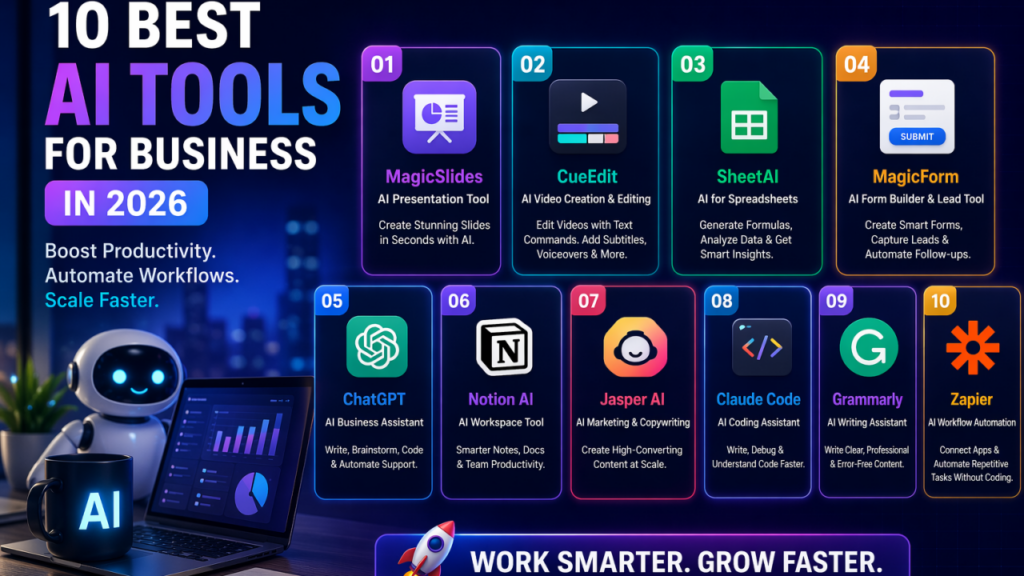
Best AI Tools Transforming Business Productivity in 2026… Artificial intelligence has become one of the most influential technologies shaping the future of business productivity. In 2026, organizations across industries are increasingly adopting AI-powered tools to automate repetitive tasks, improve decision-making, enhance collaboration, and help employees focus on higher-value activities. What began as experimental technology has evolved into a practical business advantage, with AI becoming deeply integrated into everyday workflows.
Modern AI tools are no longer limited to simple automation. They can analyze complex information, generate content, assist with software development, predict market trends, manage customer interactions, summarize documents, and support strategic planning. Businesses that effectively integrate AI are discovering new ways to improve efficiency while creating more innovative and responsive operations.
This article explores the best AI tools transforming business productivity in 2026, including their capabilities, real-world applications, benefits, challenges, and how organizations can strategically implement artificial intelligence to achieve measurable improvements.
Business productivity has traditionally depended on improving processes, reducing costs, and increasing output. However, the modern workplace faces new challenges, including growing data volumes, remote collaboration, customer expectations for faster service, and increasingly complex decision-making requirements.
AI addresses these challenges by providing intelligent systems that can support employees and automate workflows.
Key areas where AI improves productivity include:
According to industry research, organizations worldwide are increasing investment in AI because of its potential to improve efficiency and create competitive advantages. Companies are moving beyond AI experimentation and focusing on practical applications that deliver measurable business value.
The workplace of 2026 is increasingly shaped by human-AI collaboration. Instead of replacing employees entirely, many AI tools function as intelligent assistants that help workers complete tasks faster and with greater accuracy.
Examples of AI-assisted workplace activities include:
This shift allows employees to spend less time on repetitive activities and more time on creativity, problem-solving, and strategic thinking.
AI workplace assistants have become essential productivity tools for professionals. These systems help employees manage information, organize tasks, generate content, and complete everyday activities more efficiently.
Modern AI assistants can:
Businesses use AI assistants to reduce administrative workload and improve employee productivity across departments.
Generative AI has transformed how companies create written, visual, and multimedia content. Marketing teams, communication departments, and creative professionals increasingly use AI tools to accelerate content production.
Business applications include:
Generative AI does not eliminate the need for human creativity but allows teams to produce ideas and drafts more quickly.
Businesses generate enormous amounts of data, but extracting useful insights can be challenging. AI analytics platforms help organizations identify patterns, predict outcomes, and make informed decisions.
AI-powered analytics can support:
By turning data into actionable intelligence, AI enables businesses to respond faster to changing market conditions.
Effective communication is essential for productive organizations, especially as hybrid and remote work models continue expanding. AI-powered collaboration tools improve teamwork by organizing information and reducing communication barriers.
Important AI collaboration features include:
These capabilities help teams save time and ensure important information is not lost across emails, meetings, and messaging platforms.
Software development has become one of the areas most significantly influenced by AI. Developers increasingly use AI coding assistants to improve productivity, identify errors, and accelerate application development.
AI coding tools can assist with:
Development teams benefit because AI can handle routine programming tasks while allowing engineers to focus on architecture, innovation, and complex technical challenges.
Customer expectations have increased significantly, with consumers demanding faster responses and personalized experiences. AI-powered customer service tools help businesses provide support at scale.
AI customer service applications include:
Companies can improve customer satisfaction while reducing the workload on human support teams.
Large enterprises across industries are implementing AI tools to improve productivity and operational efficiency. A common approach involves combining AI assistants, analytics platforms, automation systems, and cloud-based AI services.
For example, a global organization may use AI to:
These implementations demonstrate how AI can create measurable improvements when integrated into existing business processes.
One of the most valuable contributions of AI in business productivity is intelligent automation. Traditional automation follows predefined rules, while AI-powered automation can adapt to changing information and make decisions based on context.
AI workflow automation can improve:
By reducing manual workloads, organizations can improve efficiency and allow employees to focus on more strategic responsibilities.