

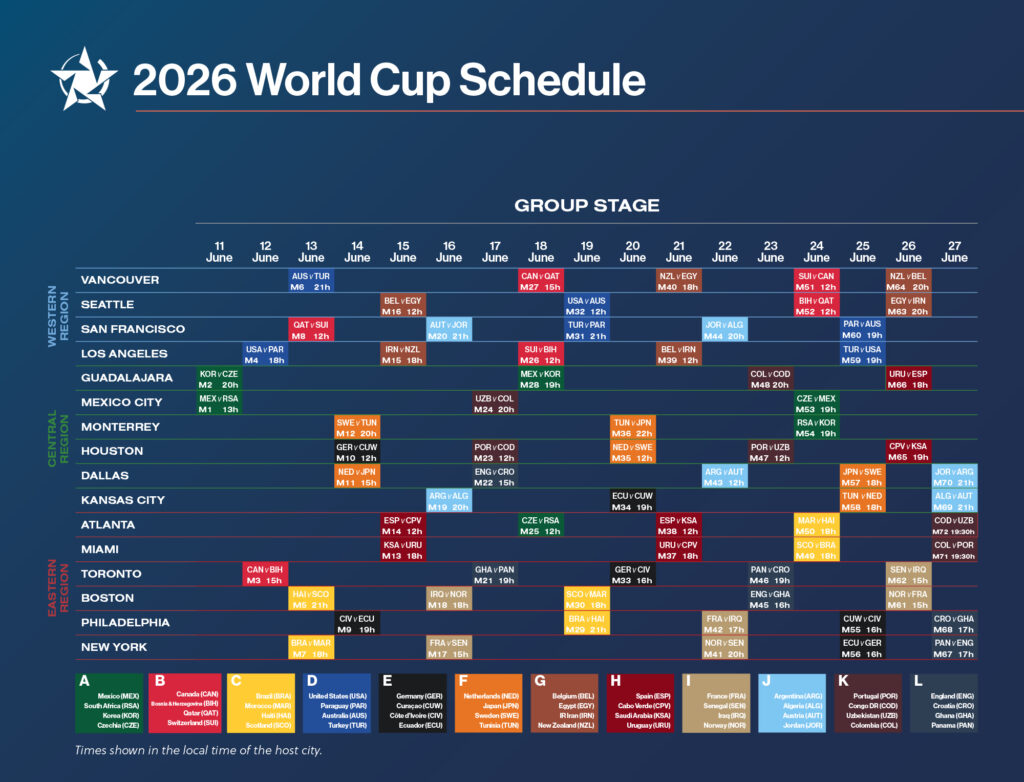
The FIFA World Cup 2026 is set to become the largest and most ambitious football tournament in history. Hosted jointly by the United States, Canada, and Mexico, the tournament introduces a groundbreaking 48-team format, expanding from the traditional 32-team competition. With 104 matches scheduled across 16 host cities and three countries, football fans around the globe can expect more action, more rivalries, and more unforgettable moments than ever before. In this article, we present the FIFA World Cup 2026 Complete Match Schedule and Fixtures to help you keep track of every game.
The tournament officially begins on June 11, 2026, and concludes with the final on July 19, 2026. This expanded competition will feature teams from every continent competing for football’s most prestigious trophy. The new format creates additional opportunities for emerging football nations while maintaining the high level of competition that has defined the FIFA World Cup for decades.
The 2026 FIFA World Cup marks several historic milestones. It is the first World Cup to be hosted by three countries and the first edition featuring 48 participating teams. The tournament structure consists of 12 groups of four teams each, followed by an expanded knockout phase beginning with a Round of 32.
The expansion from 64 matches in previous World Cups to 104 matches represents a 62.5% increase in total games, providing fans with more football than ever before.
The tournament will be played across some of North America’s most iconic stadiums. The United States hosts the majority of the matches, while Canada and Mexico each contribute key venues.
Mexico City will host the opening match, while the New York/New Jersey Stadium will stage the championship final, ensuring a spectacular conclusion to the tournament.
The 48 teams are divided into 12 groups, labeled Group A through Group L. Each group contains four teams. Teams play three matches during the group stage, facing every other team in their group once.
The top two teams from each group automatically advance to the Round of 32. In addition, the eight best third-placed teams also qualify, creating a total of 32 teams in the knockout rounds.
<ul>
South Africa
<ul>
Bosnia and Herzegovina
<ul>
Morocco
<ul>
raguay
<ul>
s Curaçao
<ul>
ds vs Japan
<ul>
s Egypt
<ul>
Cape Verde
<ul>
Senegal
<ul>
vs Algeria
<ul>
vs Congo DR
<ul>
s Croatia
The World Cup schedule has been carefully designed to maximize fan engagement while providing adequate rest periods for players.
The opening week features several high-profile matches that could shape the tournament’s narrative from the very beginning.
These fixtures involve traditional football powers alongside emerging nations, creating intriguing storylines and opportunities for potential upsets.
Several nations enter the tournament as favorites based on historical success, current rankings, and squad depth.
As one of football’s most successful nations, Argentina aims to continue its strong World Cup legacy. Their group-stage encounters against Algeria, Austria, and Jordan provide an opportunity to build momentum before the knockout rounds.
France boasts exceptional squad depth and world-class talent. Their group featuring Senegal, Iraq, and Norway presents interesting challenges.
The five-time world champions remain among the favorites. Group C matches against Morocco, Haiti, and Scotland will test their consistency.
England’s group includes Croatia, Ghana, and Panama. Their young generation of players will seek to deliver another deep tournament run.
These European powerhouses possess the experience and quality necessary to contend for the championship. Their performances during the group stage will be closely monitored by analysts worldwide.
The move from 32 to 48 teams represents the biggest structural change in World Cup history. Several benefits emerge from this new format.
Analysts estimate that the expanded tournament could attract record-breaking global viewership, surpassing the more than 5 billion engagements generated by previous World Cup editions.
The FIFA World Cup 2026 is expected to generate billions of dollars in economic activity across North America. Host cities anticipate increased tourism, hotel bookings, transportation revenue, and local business growth.
According to various economic forecasts, the tournament could create tens of thousands of jobs and contribute significantly to local economies. Cities such as Los Angeles, New York, Dallas, and Mexico City are preparing extensive infrastructure and hospitality plans to accommodate millions of visitors.
The FIFA World Cup remains the most-watched sporting event on the planet. The 2026 edition is expected to break previous viewing records due to:
Modern streaming platforms, mobile applications, and social media coverage will allow fans unprecedented access to matches, highlights, statistics, and behind-the-scenes content.
Every World Cup introduces new stars to the global stage. While established players will attract significant attention, emerging talents from Africa, Asia, North America, and South America could become breakout performers.
Young prospects from traditional powers such as Brazil, France, England, Spain, and Argentina will be closely watched by scouts, clubs, and supporters. Historically, World Cups have served as launching pads for future legends, including Pelé, Diego Maradona, Ronaldo, and Kylian Mbappé.
The FIFA World Cup 2026 promises to be a historic milestone in international football. With 48 teams, 104 matches, and three host nations working together, the tournament will deliver an unprecedented football spectacle. From the opening match in Mexico City on June 11 to the final in New York/New Jersey on July 19, fans can look forward to more drama, more goals, and more unforgettable moments than any previous World Cup.
The expanded format creates opportunities for emerging football nations while preserving the excitement of traditional powerhouse rivalries. Whether following group-stage battles, knockout-round drama, or the race to lift football’s most coveted trophy, supporters worldwide will witness a tournament that redefines the scale and reach of the FIFA World Cup. As anticipation continues to build, the 2026 edition stands poised to become one of the most memorable sporting events in history.