

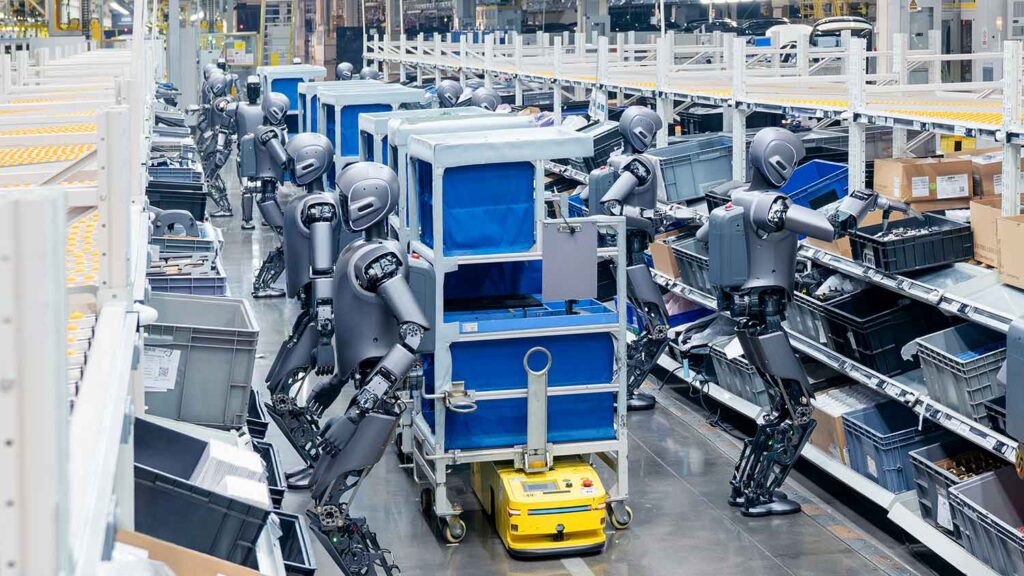
The manufacturing industry is entering a new era of automation, one that extends beyond traditional robotic arms and conveyor systems. Humanoid robots—machines designed to resemble the human form and replicate human movements—are increasingly being deployed on real industrial factory floors. Once considered a futuristic concept confined to research laboratories and science fiction films, humanoid robots are now performing practical tasks in warehouses, assembly plants, logistics centers, and manufacturing facilities around the world.
Advancements in artificial intelligence, machine learning, computer vision, sensor technology, and robotics engineering have made it possible for humanoid robots to operate in environments originally designed for humans. Unlike conventional industrial robots that typically perform repetitive tasks within fixed locations, humanoid robots can navigate complex spaces, manipulate diverse objects, and adapt to changing conditions.
As labor shortages, rising production demands, and global competition intensify, companies are investing heavily in next-generation robotic systems. Industry leaders believe humanoid robots could eventually become as transformative to manufacturing as personal computers were to office work.
This article explores how humanoid robots are being deployed in real-world factories, examines the technologies enabling their development, analyzes benefits and challenges, and discusses what the future may hold for human-robot collaboration in industrial environments.
Industrial robots have been used in manufacturing since the 1960s. Traditional robotic systems excel at highly repetitive tasks such as welding, painting, packaging, and assembly.
Conventional industrial robots offer several advantages:
However, these systems often lack flexibility. Most require specialized workspaces, safety cages, and extensive programming. Humanoid robots aim to overcome these limitations by operating within environments already designed for human workers.
Humanoid robots are robotic systems designed with a human-like structure, typically including:
The human-like design allows these robots to interact with tools, workstations, equipment, and infrastructure originally created for people.
Instead of redesigning factories around machines, companies can deploy humanoid robots into existing workflows with fewer modifications.
Several global trends are accelerating interest in humanoid robotics.
Many industrialized nations face aging populations and shrinking labor pools. Manufacturing companies frequently struggle to recruit workers for physically demanding roles.
Unlike specialized robots that perform only one function, humanoid systems can potentially handle multiple tasks.
Increasing wages and labor expenses motivate businesses to explore automation solutions that improve efficiency.
Factories often contain hazardous environments where robots can reduce worker exposure to risks.
The recent progress in humanoid robotics is driven by several technological breakthroughs.
Modern AI systems enable robots to:
Advanced cameras and visual processing systems allow robots to identify objects, navigate spaces, and interact with machinery.
Robots combine information from multiple sensors, including:
This creates a detailed understanding of the surrounding environment.
Improved battery performance has significantly increased operational capabilities and mobility.
Humanoid robots are already being tested and deployed in various industrial settings.
One of the most common applications involves moving materials throughout factories.
Tasks include:
These responsibilities often require mobility and adaptability, making them suitable for humanoid systems.
Humanoid robots can assist with assembly-line activities where human-like dexterity is advantageous.
Potential tasks include:
Factories increasingly integrate warehousing and manufacturing operations.
Humanoid robots can:
The automotive industry has emerged as one of the leading adopters of advanced robotics.
Automobile factories feature highly structured environments that provide ideal testing grounds for humanoid systems.
Potential humanoid robot responsibilities include:
Automotive manufacturers see humanoid robots as a way to complement existing automation systems while increasing operational flexibility.
Electronics production often involves delicate components and rapidly changing product designs.
Traditional automation can struggle to adapt efficiently to frequent modifications.
Humanoid robots offer advantages such as:
This flexibility makes them attractive for industries characterized by short product life cycles.
Artificial intelligence distinguishes modern humanoid robots from earlier generations.
AI enables robots to:
Machine learning systems allow robots to improve performance through experience, reducing the need for extensive manual programming.
Robots can operate continuously with minimal downtime, increasing production output.
Dangerous tasks can be assigned to robotic systems, reducing injury risks.
Humanoid robots can perform tasks with high precision and repeatability.
Manufacturers can expand robotic deployments as production demands increase.
Rather than replacing all workers, robots can assist employees by handling physically demanding tasks.
Despite impressive progress, significant challenges remain.
Humanoid robots remain expensive to design, manufacture, and maintain.
Key expenses include:
Many robots still face restrictions related to battery life and charging times.
Factories often contain unpredictable situations that challenge robotic systems.
Manufacturing operations require extremely high reliability standards. Even minor failures can disrupt production.
The future of manufacturing is likely to involve collaboration rather than complete replacement.
Collaborative environments allow humans and robots to work together.
Humans provide:
Robots contribute:
This partnership can improve productivity while maintaining human oversight.
Deploying humanoid robots in shared workspaces requires rigorous safety measures.
Important safety features include:
Manufacturers must ensure robots can safely interact with workers at all times.
Businesses evaluate robotic investments through return-on-investment calculations.
Potential financial benefits include:
However, organizations must carefully balance these benefits against implementation costs.
One of the most debated aspects of humanoid robotics concerns employment.
Some observers fear widespread job displacement, while others argue robots will create new opportunities.
Potential workforce impacts include:
Historically, technological innovation has often transformed jobs rather than eliminating work entirely.
Distribution centers represent another promising environment for humanoid robots.
Facilities often require workers to:
Humanoid robots can potentially assist with these physically demanding activities while improving efficiency and reducing injury risks.
Industry experts anticipate significant growth in humanoid robot deployment over the next decade.
Expected developments include:
As technology matures, robots may become increasingly common across diverse industrial sectors.
Beyond manufacturing, humanoid robots may find applications in:
Lessons learned from factory deployments will likely influence adoption in these industries.
Countries around the world are investing heavily in robotics research and development.
Major areas of focus include:
Competition among technology companies and nations is accelerating innovation and driving rapid improvements.
Humanoid robots are transitioning from experimental prototypes to practical tools operating on real industrial factory floors. Powered by advances in artificial intelligence, computer vision, sensing technologies, and mechanical engineering, these machines are beginning to perform meaningful work in manufacturing, logistics, warehousing, and assembly operations.
Their ability to navigate human-designed environments, handle diverse tasks, and collaborate with workers positions them as a potentially transformative technology for modern industry. While challenges related to cost, reliability, safety, and workforce adaptation remain significant, ongoing technological progress continues to improve their viability.
The future of manufacturing is unlikely to be defined by humans or robots alone. Instead, it will likely involve increasingly sophisticated partnerships in which people and machines combine their respective strengths. As deployments expand and technologies mature, humanoid robots may become as common in factories as industrial robotic arms are today, reshaping production processes and redefining the nature of industrial work in the decades ahead.