

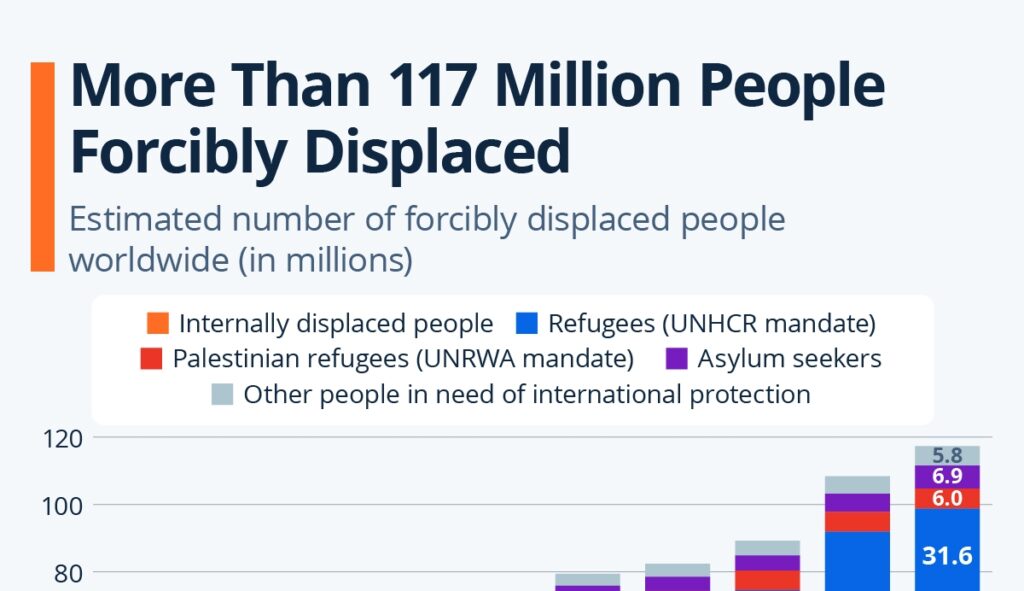
The world is currently facing one of the largest displacement crises in modern history. According to international humanitarian organizations, approximately 117 million people worldwide have been forcibly displaced from their homes due to conflict, persecution, violence, human rights violations, and environmental disasters. This staggering figure represents a dramatic increase over the past decade and highlights the growing challenges facing governments, aid agencies, and affected communities across the globe.
Forced displacement is more than a humanitarian statistic. Behind every number is a human story—a family separated by war, a child deprived of education, a community uprooted by violence, or individuals forced to leave everything they know in search of safety. The unprecedented scale of displacement has transformed migration into one of the defining global issues of the 21st century.
As conflicts persist, climate-related disasters intensify, and political instability affects multiple regions, understanding the causes and consequences of forced displacement has become increasingly important. This article examines the factors driving global displacement, explores major displacement crises, analyzes humanitarian impacts, and discusses potential solutions to one of humanity’s most pressing challenges.
Forced displacement occurs when individuals or groups are compelled to leave their homes due to circumstances beyond their control. Unlike voluntary migration, displaced people often flee under urgent and dangerous conditions.
Several categories of displaced populations exist:
While each category has distinct legal definitions, all share the common experience of being uprooted from their homes and communities.
The number of forcibly displaced people worldwide has reached unprecedented levels. A figure of 117 million people means that roughly one out of every 70 people on Earth has been forced from their home.
To understand the magnitude of this crisis, consider the following comparisons:
This growth reflects the persistence of conflicts, the emergence of new crises, and increasing vulnerability to environmental disruptions.
Several interconnected factors contribute to the rising number of displaced people worldwide.
War remains the leading cause of displacement globally. Armed conflicts destroy homes, infrastructure, and essential services, leaving civilians with little choice but to flee.
Modern conflicts often affect densely populated urban areas, increasing the number of civilians displaced during military operations.
Individuals facing persecution based on ethnicity, religion, political beliefs, nationality, or social identity frequently seek refuge elsewhere.
Political repression can create conditions where personal safety becomes impossible, forcing people to abandon their communities.
Widespread human rights abuses contribute significantly to displacement. Arbitrary detention, discrimination, violence, and targeted attacks can drive populations from their homes.
Climate change increasingly contributes to displacement through:
While environmental factors may not always fit traditional refugee definitions, they are becoming increasingly important drivers of human movement.
Forced displacement affects every continent, though some regions experience particularly severe challenges.
Prolonged conflicts and political instability have generated significant displacement throughout the region. Millions have been forced to seek refuge both internally and across international borders.
Several African countries face displacement linked to conflict, political instability, and climate-related challenges.
Factors contributing to displacement include:
Europe has experienced large-scale refugee arrivals resulting from nearby conflicts. The continent also hosts millions of people displaced by regional wars.
Asia faces displacement related to natural disasters, political unrest, and armed conflict. Rapid population growth and environmental vulnerability increase risks in many areas.
Displacement affects nearly every aspect of life.
People forced to flee often lose:
The emotional consequences can be equally severe. Trauma, uncertainty, family separation, and prolonged instability create long-term psychological challenges.
Children are especially vulnerable because displacement can interrupt critical stages of development and education.
Many people assume displacement is temporary. In reality, millions remain displaced for extended periods.
Long-term refugee situations can last decades, creating generations of people who grow up away from their original homes.
Challenges associated with prolonged displacement include:
These situations demonstrate the importance of sustainable solutions beyond emergency relief.
Children constitute a significant proportion of displaced populations worldwide.
Their experiences often include:
Education plays a crucial role in protecting displaced children and providing opportunities for future recovery and development.
Countries hosting displaced populations play a critical role in the global response.
Host nations often face significant pressures on:
Despite these challenges, many countries continue to provide protection and assistance to displaced populations.
Successful integration policies can benefit both displaced communities and host societies by promoting economic participation and social inclusion.
Forced displacement creates complex economic effects.
Governments and humanitarian organizations must allocate resources for:
When provided opportunities, displaced populations can contribute positively through:
Research has shown that refugee populations often establish businesses and create economic opportunities in host communities.
Climate change is expected to become an increasingly important driver of displacement in coming decades.
Environmental pressures include:
Unlike traditional conflict-related displacement, climate displacement may affect regions that have not historically experienced large-scale migration.
Preparing for these challenges requires long-term planning and international cooperation.
Natural disasters frequently displace millions of people each year.
Major events such as hurricanes, floods, earthquakes, and cyclones can force entire communities to relocate.
Key lessons from disaster-induced displacement include:
These measures can significantly reduce human suffering and improve recovery outcomes.
Numerous organizations work to support displaced populations.
The international response typically includes:
Humanitarian agencies often operate in extremely challenging environments where resources are limited and needs are extensive.
Despite significant efforts, humanitarian organizations face numerous obstacles.
As displacement numbers increase, maintaining adequate support becomes increasingly difficult.
Technology is playing a growing role in humanitarian operations.
Innovative tools include:
These technologies help improve efficiency, accountability, and service delivery for displaced populations.
Addressing displacement requires more than emergency aid.
Three primary durable solutions are commonly pursued:
People may return home when safety, stability, and basic services have been restored.
Some displaced individuals choose to build new lives in host communities.
In certain cases, vulnerable refugees are permanently resettled in third countries.
Each solution presents opportunities and challenges that must be carefully managed.
Forced displacement is a global challenge requiring coordinated responses.
Effective cooperation involves:
No single country or organization can solve displacement challenges alone.
Several trends are likely to shape displacement patterns in the coming years.
Policymakers and humanitarian actors must adapt to these evolving realities while maintaining commitments to human dignity and protection.
The reality that 117 million people worldwide are forcibly displaced represents one of the most significant humanitarian challenges of our time. Behind this historic figure are millions of individuals and families seeking safety, stability, and hope amid circumstances beyond their control. Conflict, persecution, human rights violations, and environmental pressures continue to drive displacement across every region of the world.
The consequences extend far beyond immediate humanitarian needs, affecting education, healthcare, economic development, social cohesion, and international stability. Children, in particular, face long-term risks that can shape entire generations if adequate support is not provided.
While the scale of the crisis is immense, solutions exist. Through international cooperation, sustainable development, conflict prevention, climate adaptation, and effective humanitarian assistance, the global community can help displaced populations rebuild their lives. Addressing forced displacement requires both compassion and strategic action, recognizing that protecting vulnerable people is not only a humanitarian obligation but also an investment in global peace, stability, and shared prosperity.