

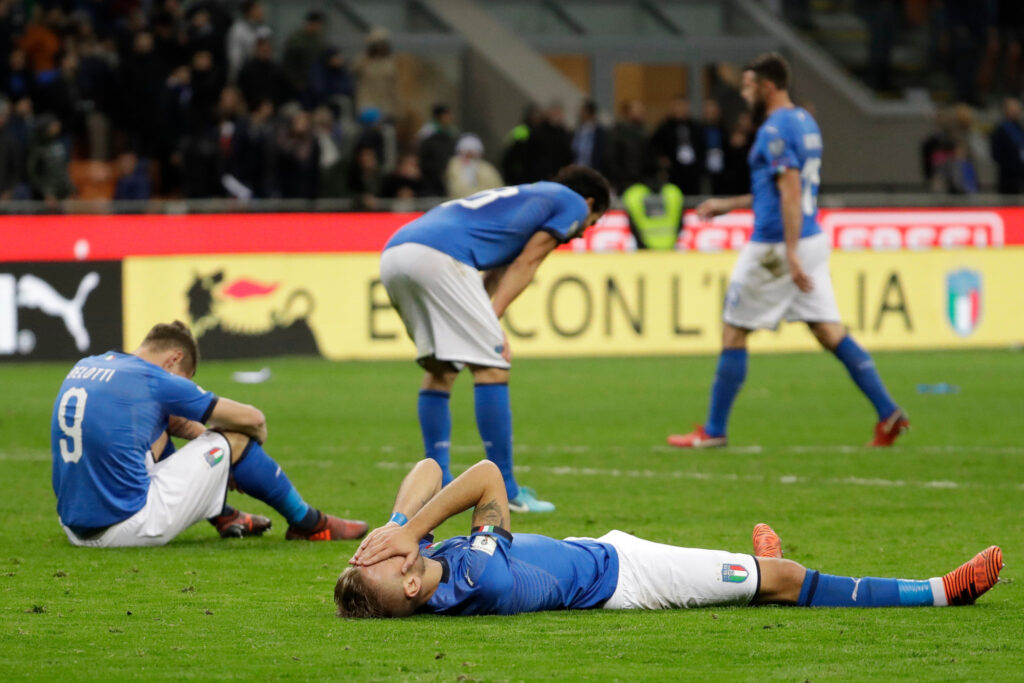
The absence of Italy from the FIFA World Cup 2026 qualification picture has become one of the most debated topics in international football. The news that Italy Not Qualified for World Cup 2026 has left fans and analysts in disbelief. For a nation that has lifted the trophy four times (1934, 1938, 1982, 2006), the idea of missing another World Cup is both shocking and symbolic of deeper structural issues within Italian football.
Although qualification cycles are still ongoing and final outcomes depend on playoff scenarios, Italy’s precarious position in the UEFA qualification landscape has sparked widespread concern among fans, analysts, and former players. The possibility—or reality—of Italy missing yet another World Cup highlights a long-term decline that has been building for more than a decade.
Italy is historically one of the most successful national teams in football history. The Azzurri have a legacy defined by tactical brilliance, defensive mastery, and world-class talent production. However, recent years have painted a very different picture.
Italy failed to qualify for the 2018 World Cup in Russia and also missed the 2022 World Cup in Qatar after a shocking playoff defeat to North Macedonia. These back-to-back failures were unprecedented for a four-time champion and marked a turning point in Italian football history.
This contrast between historic success and modern struggle underscores the magnitude of Italy’s current crisis.
The qualification process for the 2026 World Cup in Europe (UEFA) is highly competitive. With 16 slots allocated to European teams, Italy is expected to qualify based on pedigree alone. However, performance on the pitch tells a more complicated story.
Italy’s qualification campaign has been inconsistent, with dropped points against lower-ranked teams and struggles in high-pressure matches.
These issues have led to uncertainty regarding Italy’s direct qualification chances, forcing reliance on potential playoff scenarios once again.
The repeated failure to qualify for recent World Cups is not a coincidence. Instead, it reflects deeper systemic issues within Italian football.
Italy once produced world-class talents regularly through strong academy systems. However, investment in youth development has lagged behind other European nations such as France, Spain, and Germany.
Italian football has long been associated with tactical discipline. However, modern football demands flexibility, pressing intensity, and attacking creativity.
Some analysts argue that Italy has struggled to fully adapt to these evolving tactical trends.
While Serie A remains one of Europe’s top leagues, its dominance has declined compared to the Premier League and La Liga.
Repeated failures have created psychological pressure within the national team. The memory of missing the 2018 and 2022 World Cups continues to influence performances in critical matches.
One of the most painful moments in recent Italian football history was the 2022 World Cup playoff defeat against North Macedonia. Despite dominating possession and creating chances, Italy failed to score and conceded a last-minute goal that eliminated them from contention.
This match is often cited as an example of Italy’s recurring problems: inefficiency in attack and vulnerability in decisive moments.
This defeat remains a turning point in discussions about Italy’s football identity and future direction.
Despite recent struggles, Italy still possesses talented players across various positions. However, the squad lacks balance in certain areas.
Coaching has always played a central role in Italian football success. However, recent managerial changes have disrupted continuity and long-term planning.
Modern managers are attempting to blend traditional defensive organization with more attacking styles, but results have been inconsistent.
To understand Italy’s struggles, it is useful to compare them with consistently successful European teams.
Compared to these nations, Italy has struggled to maintain consistent modernization.
Failing to qualify for the World Cup has significant consequences beyond football performance.
The World Cup is not just a tournament for Italy—it is a cultural event that unites the nation.
Italian media and fans are extremely passionate about football, which intensifies pressure on the national team.
After recent failures, criticism has been widespread, with debates focusing on structural reform rather than short-term fixes.
Despite current challenges, Italy still has time to secure qualification for the 2026 World Cup. The expanded tournament format, which includes more European slots, improves their chances.
However, qualification alone is not the ultimate goal—Italy aims to restore its identity as a global football powerhouse.
Italy’s struggles are not just about one qualification campaign. They reflect a broader identity crisis in how Italian football is structured, taught, and executed.
Rebuilding success will require long-term planning rather than short-term solutions.
Italy’s failure to secure a guaranteed place in the World Cup 2026 qualification narrative highlights a dramatic shift in global football power dynamics. Once a dominant force, the Azzurri now face a period of reflection and restructuring.
From tactical evolution and youth development challenges to psychological pressure and competitive inconsistency, Italy’s struggles are multifaceted. However, history shows that Italian football is resilient, capable of reinvention and resurgence.
The road to recovery will not be easy, but with strategic reforms and renewed focus, Italy can once again return to the global stage where it belongs. Whether or not they qualify for 2026, the deeper challenge lies in rebuilding a system capable of sustaining long-term success.