

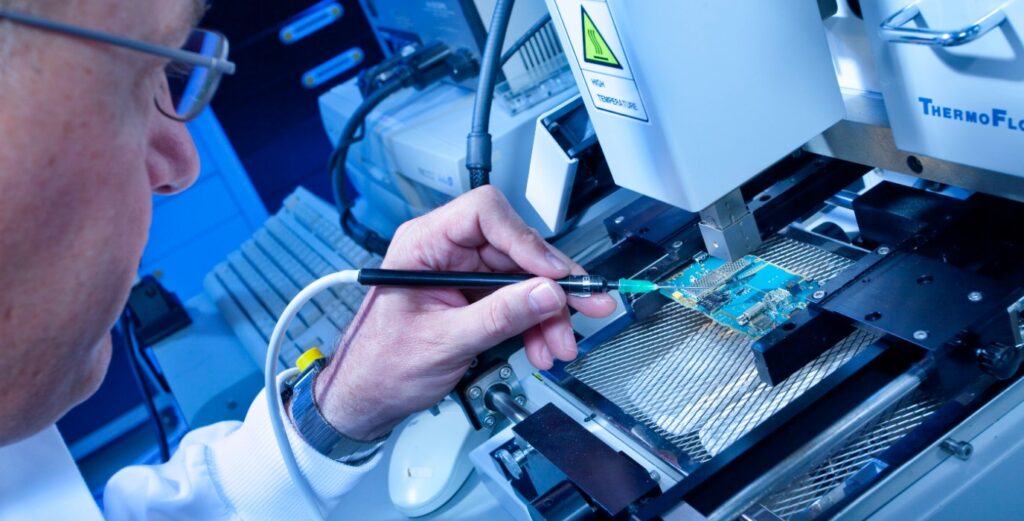
Latest Semiconductor Industry Developments Affecting Technology… The semiconductor industry sits at the heart of modern technology. From smartphones and laptops to artificial intelligence (AI), electric vehicles, cloud computing, and advanced medical equipment, semiconductors power nearly every aspect of today’s digital economy. As demand for faster, smaller, and more energy-efficient chips continues to grow, the industry is undergoing rapid transformation driven by technological innovation, geopolitical considerations, and changing market needs.
Recent developments have accelerated investment in semiconductor manufacturing, advanced chip design, AI processors, memory technologies, and supply chain resilience. At the same time, governments around the world have introduced policies to strengthen domestic chip production, recognizing semiconductors as strategic assets for both economic growth and national security.
This article explores the latest semiconductor industry developments affecting technology, examining the trends shaping the market, the innovations redefining computing, and the challenges companies face as they push the limits of chip performance.
Semiconductors are integrated circuits that process, store, and transmit information. They are fundamental components in countless electronic devices and digital systems.
Modern industries that depend heavily on semiconductor technology include:
Industry analysts estimate that the global semiconductor market generates hundreds of billions of dollars in annual revenue, with long-term growth supported by increasing digitalization across virtually every sector.
One of the most significant developments in recent years has been the explosive growth of artificial intelligence. Training and deploying advanced AI models require enormous computational power, increasing demand for specialized processors designed specifically for machine learning workloads.
Unlike traditional central processing units (CPUs), AI workloads often rely on graphics processing units (GPUs), neural processing units (NPUs), tensor accelerators, and custom AI chips optimized for parallel computing.
Key drivers of AI chip demand include:
As businesses integrate AI into their operations, semiconductor manufacturers continue investing heavily in next-generation processors capable of delivering higher performance with improved energy efficiency.
Semiconductor fabrication has steadily progressed toward increasingly smaller manufacturing processes. Advanced nodes such as 5-nanometer (nm), 3-nanometer, and the industry’s ongoing work toward 2-nanometer-class technologies allow manufacturers to place more transistors on a single chip.
Benefits of smaller manufacturing nodes include:
However, shrinking transistor dimensions also increases manufacturing complexity and cost, requiring sophisticated lithography systems and advanced process engineering.
Modern AI processors require exceptionally fast memory to feed enormous amounts of data into computing cores. High-Bandwidth Memory (HBM) has become increasingly important because it offers significantly greater data transfer rates compared with conventional memory technologies.
HBM supports applications such as:
The growing demand for AI infrastructure has increased interest in both advanced processors and the memory technologies that enable them to perform efficiently.
Rather than manufacturing a single large chip, many semiconductor companies are adopting chiplet-based architectures. This approach combines multiple smaller chips within a single package, allowing designers to improve flexibility, manufacturing yields, and scalability.
Advantages of chiplets include:
Chiplet technology is increasingly being used in high-performance computing, enterprise servers, and AI accelerators.
As transistor scaling becomes more challenging, advanced packaging has become an important area of innovation. Packaging is no longer simply a protective enclosure but an active contributor to system performance.
Modern packaging techniques include:
These methods improve communication between components while supporting greater computing density in compact devices.
The rapid expansion of AI services has significantly increased investment in large-scale data centers. These facilities require thousands of advanced processors working together to train and operate sophisticated machine learning models.
Modern AI data centers prioritize:
This trend has created substantial demand across multiple segments of the semiconductor ecosystem, including processors, networking chips, memory, and power management integrated circuits.
Vehicles are becoming increasingly software-defined, incorporating advanced driver assistance systems, infotainment platforms, connectivity features, and electric powertrains.
Modern automobiles rely on hundreds or even thousands of semiconductor components.
Important automotive semiconductor applications include:
The transition toward electric and increasingly automated vehicles continues to support long-term semiconductor demand.
Recent supply chain disruptions demonstrated the importance of resilient semiconductor manufacturing. Companies and governments have responded by investing in diversified production capacity across multiple geographic regions.
Major priorities include:
A more geographically distributed manufacturing ecosystem may improve resilience against future disruptions.
Many governments have introduced initiatives designed to strengthen domestic semiconductor industries through incentives, research funding, and manufacturing investments.
Common objectives include:
Public and private investment continues expanding fabrication capacity and research capabilities in multiple regions.
The open-standard RISC-V instruction set architecture has attracted growing interest from researchers, startups, and established technology companies.
Potential advantages include:
Although established processor architectures continue to dominate many markets, RISC-V has become an increasingly important area of semiconductor innovation.
Chip production depends not only on semiconductor designers but also on sophisticated manufacturing equipment capable of producing extremely precise integrated circuits.
Essential technologies include:
Continuous advances in manufacturing equipment enable the production of increasingly complex semiconductor devices.
As computing workloads continue expanding, energy efficiency has become a major design objective. Data centers consume significant electricity, making performance per watt an increasingly important metric.
Chip designers focus on:
Improving energy efficiency benefits both operational costs and environmental sustainability.
Despite remarkable technological progress, the industry faces several ongoing challenges.
Successfully addressing these issues will require collaboration between manufacturers, governments, research institutions, and technology companies.
Modern smartphones illustrate how semiconductor innovation transforms everyday technology. Today’s mobile devices integrate application processors, AI engines, graphics processors, image signal processors, security modules, wireless communication chips, and power management circuits into highly compact designs.
These advancements enable features such as:
The continued evolution of semiconductor technology directly influences the capabilities consumers experience in daily life.
The semiconductor industry is expected to remain one of the most important drivers of technological progress over the coming decade. Demand from artificial intelligence, cloud computing, electric vehicles, robotics, industrial automation, and next-generation telecommunications is likely to sustain continued investment in advanced chip technologies.
Future innovation may include:
As computing requirements continue expanding, semiconductor companies will remain central to enabling the next generation of digital innovation.
The semiconductor industry is undergoing one of the most dynamic periods in its history. Artificial intelligence, advanced manufacturing nodes, chiplet architectures, high-bandwidth memory, advanced packaging, automotive electronics, and supply chain diversification are reshaping both the industry and the technologies people use every day. At the same time, governments and private companies are making substantial investments to strengthen manufacturing capacity and accelerate innovation.
While challenges such as rising production costs, geopolitical uncertainty, and increasing technical complexity remain, the industry’s long-term outlook continues to be supported by strong demand across multiple sectors. Semiconductors will remain the foundation of future technological progress, powering advances in AI, communications, transportation, healthcare, and countless other fields. Organizations and investors that closely monitor these developments will be better positioned to understand the rapidly evolving technology landscape.