

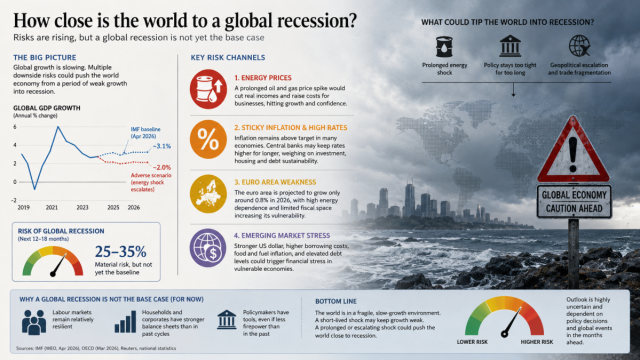
The global economy is becoming increasingly interconnected, making financial markets more vulnerable to economic shocks that spread across borders. Among the most significant concerns today are the Major Economic Recession Risks Facing Global Markets. A recession in one major economy can quickly affect international trade, investment, employment, and consumer confidence worldwide. While periods of economic growth create new opportunities, downturns remain a natural part of the business cycle. Investors, businesses, and governments closely monitor recession risks because they can influence corporate earnings, public finances, and long-term economic development.
An economic recession is generally characterized by a broad decline in economic activity over an extended period. Although definitions vary, recessions often involve slower economic growth, reduced consumer spending, weaker business investment, declining industrial production, and rising unemployment. Financial markets may also become more volatile as investors respond to changing economic conditions.
Recessions differ in both duration and severity. Some are relatively mild and short-lived, while others can lead to prolonged economic weakness. The impact often depends on the underlying causes, the resilience of financial institutions, and the policy responses implemented by governments and central banks.
Modern economies rely heavily on international trade, digital communication, global supply chains, and cross-border investment. As a result, disruptions in one region can quickly influence businesses and consumers elsewhere. Advances in technology have also accelerated the speed at which financial markets react to economic news.
Several factors contribute to the strong connections between global markets.
Inflation remains one of the most closely watched economic indicators because it directly affects purchasing power, business costs, and investment decisions. When prices rise rapidly, households often reduce discretionary spending while businesses face higher production expenses.
If inflation remains elevated for a prolonged period, central banks may maintain tighter monetary policies, increasing borrowing costs for consumers and businesses. Higher financing costs can slow investment, reduce housing activity, and moderate economic growth.
Central banks use interest rates to balance inflation and economic growth. Raising interest rates can help reduce inflation by slowing borrowing and spending, while lowering rates may encourage investment and consumption during periods of economic weakness.
However, maintaining this balance is challenging. Interest rates that remain high for an extended period may place pressure on businesses with significant debt and reduce consumer demand for large purchases such as homes and vehicles.
Political tensions, military conflicts, trade disputes, and economic sanctions can disrupt international commerce and reduce business confidence. These events may affect energy supplies, transportation routes, manufacturing activity, and global investment decisions.
Businesses operating internationally often respond by diversifying suppliers, increasing inventory levels, or relocating production facilities to reduce geopolitical risks.
Global supply chains remain essential to manufacturing, retail, healthcare, and technology industries. Natural disasters, transportation bottlenecks, labor shortages, and geopolitical events can interrupt production and increase operating costs.
Supply chain disruptions may lead to inventory shortages, delayed deliveries, and higher prices for consumers. Many organizations are investing in supply chain diversification and digital logistics systems to improve resilience.
Periods of economic uncertainty often lead to increased volatility in stock, bond, and currency markets. Investor sentiment can change quickly in response to economic data, corporate earnings, or geopolitical developments.
Although market volatility creates risks, it can also present opportunities for long-term investors who maintain diversified portfolios and disciplined investment strategies.
Many countries, businesses, and households carry substantial debt. Rising interest rates can increase the cost of servicing these obligations, reducing available funds for investment and consumption.
Governments with high debt levels may also face difficult fiscal decisions regarding public spending, taxation, and infrastructure investment during periods of slower economic growth.
Consumer spending accounts for a significant share of economic activity in many countries. When households become concerned about employment, inflation, or financial security, they often reduce discretionary purchases.
Lower consumer spending can affect retailers, manufacturers, travel companies, entertainment businesses, and service providers, slowing overall economic activity.
Commercial real estate markets continue adapting to changing workplace trends, higher financing costs, and evolving demand for office space. Hybrid work arrangements have influenced occupancy rates in some regions, while industrial and logistics properties have benefited from continued growth in e-commerce.
Investors monitor commercial property markets closely because financial institutions often have significant exposure through commercial lending.
The technology industry remains a major contributor to global economic growth, but it is not immune to economic cycles. Businesses may delay software purchases, reduce capital spending, or postpone expansion projects during periods of uncertainty.
At the same time, investments in artificial intelligence, cloud computing, cybersecurity, and automation continue supporting long-term innovation despite short-term market fluctuations.
Energy prices influence transportation, manufacturing, agriculture, and household expenses. Sharp increases in oil, natural gas, or electricity prices can contribute to inflation and reduce business profitability.
Countries investing in diversified energy sources, renewable technologies, and improved efficiency may become better positioned to manage future energy market volatility.
Extreme weather events, droughts, floods, and wildfires increasingly affect agriculture, infrastructure, insurance markets, and supply chains. Businesses are incorporating climate risk into long-term planning, while governments continue investing in resilient infrastructure and disaster preparedness.
Climate-related disruptions may increase operating costs and require significant investment in adaptation strategies across multiple industries.
The global financial crisis of 2008 demonstrated how problems within one segment of the financial system can spread throughout the global economy. Weakness in housing finance, declining confidence, and financial institution failures contributed to widespread economic contraction.
The crisis highlighted the importance of financial regulation, adequate capital reserves, risk management, and coordinated policy responses during periods of economic stress.
A multinational electronics manufacturer experienced production delays after disruptions affected several key suppliers. Rather than relying on a single source for critical components, the company diversified its supplier network across multiple regions and invested in digital inventory management.
These changes reduced operational risk, improved flexibility, and strengthened long-term business resilience against future disruptions.
Economists monitor a wide range of indicators to evaluate recession risks. Gross domestic product (GDP), unemployment rates, inflation, manufacturing activity, retail sales, consumer confidence, and industrial production all provide valuable insights into economic conditions.
Financial market indicators such as bond yields, credit spreads, and equity market performance also help analysts assess changing expectations regarding future economic growth.
Some industries historically show greater resilience during periods of slower economic growth because they provide essential goods and services.
Although no sector is completely immune to economic downturns, businesses with stable demand and strong financial positions may be better equipped to navigate challenging conditions.
Organizations can prepare for economic uncertainty by improving operational flexibility, managing costs, and strengthening financial resilience.
Long-term investors often focus on diversification and disciplined portfolio management during uncertain economic periods. Rather than reacting to short-term market movements, many investors review asset allocation, risk tolerance, and investment objectives regularly.
Economic cycles include both expansions and contractions. While recession risks deserve careful attention, periods of slower growth have often been followed by recovery, innovation, and renewed investment. Businesses that continue investing in productivity, technology, workforce development, and operational resilience may emerge stronger when economic conditions improve.
Governments, financial institutions, and private organizations continue developing strategies that improve economic stability, strengthen financial systems, and encourage sustainable long-term growth.
Major economic recession risks facing global markets arise from a combination of inflation pressures, interest rate changes, geopolitical uncertainty, supply chain disruptions, financial market volatility, high debt levels, climate-related events, and shifting consumer confidence. While these challenges can influence economic growth and investment performance, they also encourage businesses and policymakers to strengthen resilience through innovation, diversification, and strategic planning. Investors who maintain diversified portfolios, monitor economic indicators, and focus on long-term objectives are generally better prepared to navigate periods of uncertainty. Understanding these risks provides valuable context for making informed financial and business decisions in an increasingly interconnected global economy.