

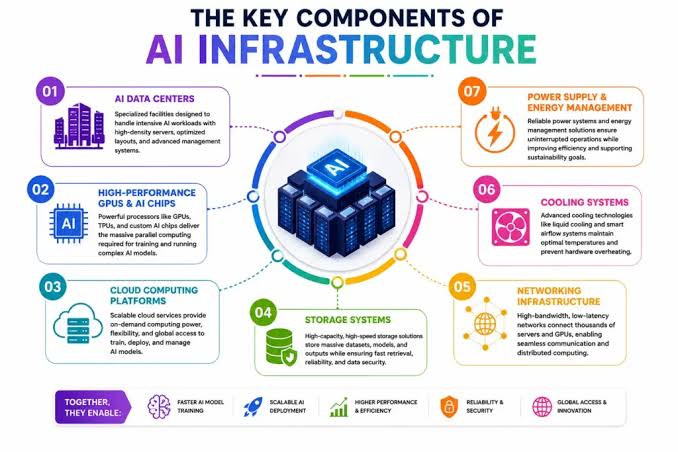
Artificial intelligence (AI) has grown from a specialized research topic into one of the most influential technologies in the world. Today, businesses across many industries use AI to automate tasks, improve customer experiences, and make better decisions. As AI becomes more advanced, Technology Companies Investing Heavily in AI Infrastructure are shaping the future by allocating billions of dollars into new technologies. These investments include modern data centers, powerful AI chips, cloud computing services, high-speed networks, energy-efficient facilities, and advanced software platforms.
AI infrastructure is the foundation that supports the development and operation of artificial intelligence systems. It includes hardware, software, networking equipment, cloud services, and storage solutions needed to build, train, and deploy AI models.
Unlike traditional IT systems, AI infrastructure is designed to handle large volumes of data and perform complex calculations simultaneously. This allows organizations to train large language models, analyze massive datasets, generate images and videos, automate business processes, and make real-time decisions more efficiently.
The rapid growth of AI-powered applications has increased competition among technology companies. Businesses understand that strong AI infrastructure is essential for creating innovative products, improving customer satisfaction, and staying ahead of competitors.
Several factors are driving these investments:
A reliable AI ecosystem depends on several technologies working together. Each component plays an important role in supporting AI applications.
Modern AI systems require specialized processors that can perform trillions of calculations every second. Graphics Processing Units (GPUs), AI accelerators, and tensor processors have become essential for training and running advanced AI models.
These processors shorten training times, improve model performance, and increase overall computing efficiency.
Cloud computing allows organizations to access powerful computing resources without buying expensive hardware. Businesses can quickly increase or reduce computing power based on their needs.
Benefits include:
Modern AI data centers are built specifically to support demanding AI workloads. They include advanced cooling systems, reliable power supplies, optimized server layouts, and fast networking equipment.
Many facilities also focus on sustainability by improving energy efficiency and using renewable energy whenever possible.
AI workloads often run across thousands of connected servers. Fast networking allows these servers to exchange information with minimal delay.
Efficient communication helps reduce bottlenecks and speeds up AI model training, especially for large distributed systems.
Traditional computer processors are not designed for today’s demanding AI workloads. Specialized AI chips can process large amounts of data much faster while using less energy.
Technology companies continue investing in custom processors to improve AI training, inference, and real-time analytics. These chips increase performance while reducing operating costs.
As AI adoption grows, the need for larger and more powerful data centers continues to increase. Companies are building new facilities around the world to improve performance, reduce latency, and support growing customer demand.
Modern AI data centers typically include:
Imagine a global financial company using AI to detect fraud, improve customer service, and support investment decisions. The company moves its operations to a cloud-based AI platform with high-performance computing resources.
Machine learning models analyze millions of transactions every day to detect suspicious activity in near real time. AI-powered chatbots answer common customer questions, while predictive analytics help financial advisors make better investment decisions. As a result, the company improves efficiency, reduces costs, and delivers better customer service.
A healthcare organization adopts AI infrastructure to help doctors analyze medical images, predict patient risks, and improve hospital operations.
Powerful AI systems process diagnostic images more quickly, helping healthcare professionals identify possible health conditions faster. Predictive analytics also help hospitals manage staff schedules and allocate resources more effectively, improving patient care and operational efficiency.
Not every AI application relies on centralized cloud servers. Edge computing processes data closer to where it is created, reducing delays and improving response times.
Common edge AI applications include:
Combining cloud computing with edge computing gives businesses both scalability and real-time performance.
Training advanced AI models requires significant computing power, which also increases electricity consumption. To reduce environmental impact, technology companies are investing in more sustainable infrastructure.
Popular sustainability initiatives include:
These improvements help lower operating costs while reducing environmental impact.
As AI systems manage increasing amounts of sensitive information, strong cybersecurity has become more important than ever.
Organizations commonly implement:
Strong security measures protect valuable data and build trust among customers and business partners.
Large investments in AI infrastructure create positive economic effects. New data centers generate construction jobs, technology careers, and opportunities for equipment suppliers and service providers.
AI infrastructure also allows startups, universities, and businesses to access powerful computing resources without building expensive systems from scratch, encouraging innovation across many industries.
AI infrastructure supports digital transformation across a wide range of sectors.
Examples include:
As AI technology becomes more accessible, organizations continue finding new ways to improve productivity and create innovative products and services.
Despite its rapid expansion, AI infrastructure still faces several important challenges.
These include:
Overcoming these challenges requires careful planning, continued investment, and strong partnerships across the technology industry.
Industry experts expect AI infrastructure spending to continue growing over the next several years. Organizations are investing heavily in cloud computing, AI processors, networking equipment, and data centers to support expanding AI workloads.
Generative AI, machine learning, and intelligent automation are expected to remain major drivers of this growth. Surveys also show that many businesses now consider AI a long-term strategic investment.
Future AI infrastructure will become more efficient, scalable, and environmentally friendly. Advances in processor technology, networking, software optimization, and quantum computing research will continue improving AI performance while reducing costs.
Organizations will increasingly combine cloud computing, edge computing, and automation to support more advanced AI applications. Collaboration among hardware manufacturers, software developers, cloud providers, and research institutions will continue driving innovation.
Organizations planning AI investments should focus on long-term growth, security, and efficiency.
Recommended best practices include:
Following these practices helps organizations maximize returns while supporting secure and responsible AI adoption.
AI infrastructure has become the backbone of modern artificial intelligence. Investments in high-performance computing, cloud platforms, AI chips, advanced data centers, high-speed networking, and edge computing are transforming how organizations develop and deploy AI solutions. These technologies drive innovation, improve efficiency, and create new business opportunities across many industries. Although challenges such as energy use, cybersecurity, and infrastructure costs remain, ongoing improvements in hardware, software, and sustainable technologies will continue strengthening the AI ecosystem. Organizations that invest in scalable, secure, and efficient AI infrastructure today will be well prepared to lead the next wave of digital innovation.