

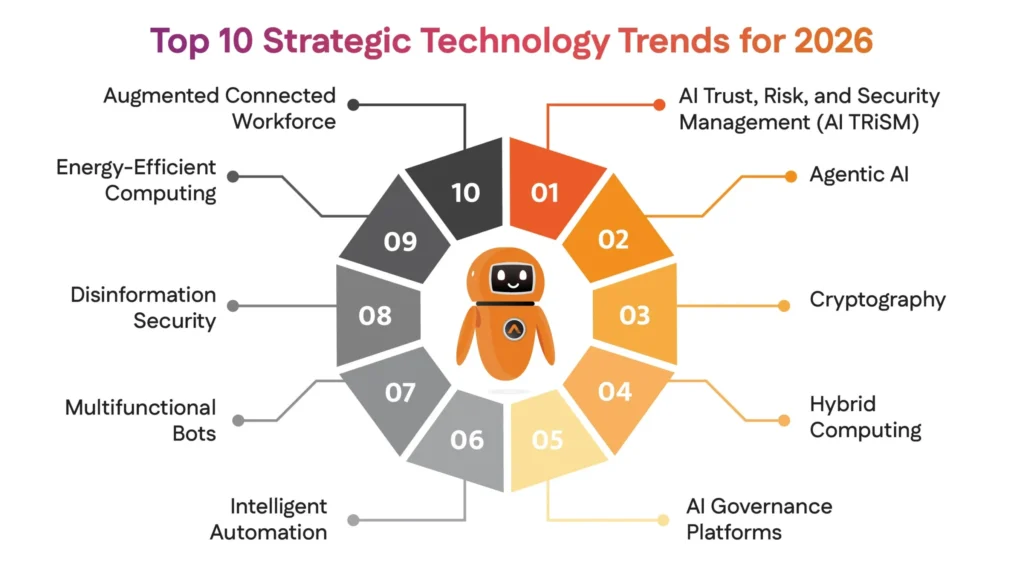
Most Important Technology Trends to Watch This Year… Technology continues to reshape industries, economies, and everyday life at an unprecedented pace. Each year introduces innovations that redefine how businesses operate, how consumers interact with digital services, and how governments approach challenges such as cybersecurity, sustainability, and healthcare. This year is no exception. From artificial intelligence becoming deeply integrated into daily workflows to breakthroughs in quantum computing and green technology, the pace of innovation continues to accelerate.
Organizations that recognize emerging technology trends early gain a significant competitive advantage. They can improve efficiency, create new revenue opportunities, reduce operational costs, and deliver better customer experiences. Meanwhile, individuals who stay informed are better positioned to develop valuable skills and adapt to an evolving job market.
This article explores the most important technology trends to watch this year, examining their impact across industries, highlighting real-world examples, and discussing both the opportunities and challenges they present.
Generative AI has evolved from an experimental technology into a practical business tool. Organizations across industries are integrating AI into customer service, software development, marketing, education, healthcare, and research.
Unlike traditional AI systems that classify or predict data, generative AI creates new content, including text, images, videos, code, music, and business reports. Large language models have dramatically improved workplace productivity by automating repetitive tasks and assisting with creative work.
Companies implementing AI responsibly are reporting significant productivity improvements, allowing employees to focus on higher-value activities rather than routine administrative work.
Search engines are becoming conversational. Instead of displaying only lists of web pages, AI-powered search platforms increasingly summarize information, answer complex questions, and provide contextual recommendations.
Digital assistants are also evolving into productivity companions capable of planning meetings, summarizing documents, generating emails, analyzing spreadsheets, and assisting with project management.
This shift is changing how people browse the internet, conduct research, and interact with digital information.
As cyber threats become more sophisticated, organizations are adopting AI-driven security systems capable of identifying suspicious behavior in real time. Modern cybersecurity platforms analyze enormous volumes of network activity to detect threats faster than traditional rule-based systems.
Important developments include:
At the same time, attackers are also using AI to create more convincing phishing campaigns and automate cyberattacks, making cybersecurity an ongoing technological arms race.
Instead of processing all information in centralized cloud data centers, edge computing moves computation closer to where data is generated. This reduces latency, improves reliability, and lowers bandwidth requirements.
Industries benefiting from edge computing include manufacturing, healthcare, autonomous vehicles, smart cities, and retail.
A smart factory equipped with edge devices can analyze sensor data locally to identify equipment failures within milliseconds, preventing costly downtime without relying on distant cloud servers.
A digital twin is a virtual representation of a physical object, system, or process. Organizations use digital twins to simulate performance, predict maintenance requirements, and optimize operations before making real-world changes.
Digital twins are increasingly used in:
For example, airlines can use digital twins of aircraft engines to predict maintenance needs, reducing unexpected failures and improving operational efficiency.
Quantum computing remains an emerging technology, but recent advances in hardware, error correction, and cloud accessibility continue to move the field toward practical applications.
Potential use cases include:
Although large-scale commercial adoption may still take several years, investments by governments and technology companies demonstrate strong confidence in quantum computing’s long-term potential.
Sustainability has become a major driver of technological innovation. Businesses are investing in energy-efficient computing, renewable energy infrastructure, smart power grids, and environmentally responsible manufacturing.
Green technologies not only reduce environmental impact but also lower operational costs through improved energy efficiency.
Organizations increasingly view sustainability as both an environmental responsibility and a competitive business advantage.
Modern robots are becoming more capable thanks to advances in artificial intelligence, computer vision, and sensor technology. Rather than replacing workers entirely, collaborative robots are increasingly designed to work alongside humans.
Automation is expanding across warehouses, manufacturing facilities, hospitals, and logistics centers. Businesses are using robotics to improve safety, increase productivity, and address labor shortages while allowing employees to focus on more complex tasks.