

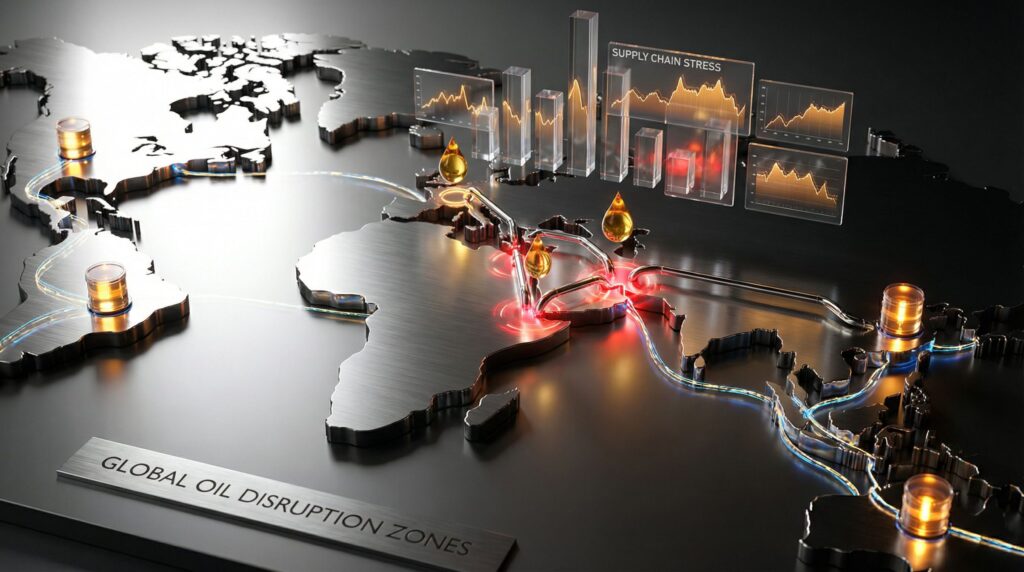
The global oil supply chain is the circulatory system of the modern industrial world. It is a vast, interconnected web of extraction sites, pipelines, refineries, and maritime routes. This network ensures energy flows from resource-rich regions to energy-hungry economies. However, as we navigate 2026, instability related to Supply Chain Instability in Global Oil Distribution Networks is reaching unprecedented levels. The transition from a predictable, globalized market to a fragmented, “just-in-case” model has exposed structural vulnerabilities. These vulnerabilities threaten global economic security.
Instability in oil distribution is not a new phenomenon, but the drivers have changed. Historically, supply shocks were primarily caused by localized geological depletion or simple state-level conflicts. Today, the instability is multifaceted, driven by a volatile mix of geopolitical “alignment warfare,” aging physical infrastructure, a shrinking pool of specialized labor, and the increasing frequency of climate-driven extreme weather events. This article explores the root causes of these instabilities. Furthermore, it provides a strategic overview of the challenges facing global oil logistics in the mid-2020s.
The most significant driver of supply chain instability in 2026 is the shift from a globalized oil market to a “bloc-based” system. For decades, oil was a fungible commodity—it didn’t matter much where it came from as long as the price was right. Today, “energy friend-shoring” has replaced pure market logic.
Sanctions and counter-sanctions have created a “shadow fleet” of tankers and fragmented insurance markets. This has lengthened supply routes significantly. For example, crude that once traveled from the Baltic Sea to Western Europe in five days must now often travel 45 days to reach markets in South Asia. This increased “time-on-water” reduces the effective capacity of the global tanker fleet, leading to sudden spikes in shipping rates. When supply chains become longer, they become more susceptible to disruption at every mile. Consequently, this increases the cumulative risk of the entire distribution network.
While the world is vast, the routes that oil tankers take are surprisingly narrow. Over 60% of the world’s petroleum production moves by sea, and a massive portion of that volume must pass through a handful of maritime chokepoints.
The Strait of Hormuz, the Malacca Strait, and the Bab el-Mandeb are the “jugular veins” of the global economy. In 2026, the rise of low-cost asymmetric warfare—specifically the use of long-range loitering munitions (drones)—has made these narrow waterways more dangerous than ever. A single successful strike on a Very Large Crude Carrier (VLCC) in a narrow channel can block traffic for weeks. Statistics from maritime insurance agencies show that “war risk premiums” for these zones have become a permanent, rather than temporary, cost of doing business. As a result, these add billions to the global energy bill annually.
A hidden layer of instability is the physical decay of the distribution network. As the world pushes for a “Green Transition,” investment in traditional oil infrastructure has plummeted. However, the demand for oil remains high, forcing the industry to run aging systems harder and longer than originally intended.
In many regions, pipelines that were designed for a 30-year lifespan are now entering their 50th year. This “maintenance debt” leads to frequent leaks, unplanned shutdowns, and reduced flow pressure. In 2025, the global oil industry saw a 12% increase in “unplanned outages” directly attributed to equipment failure in midstream assets. This creates a “stuttering” supply chain where refineries cannot count on a steady stream of feedstock. As a result, there is price volatility at the pump even when the global supply of crude is technically sufficient.
Climate change is no longer a distant threat to oil distribution; it is an active disruptor. The infrastructure of the oil supply chain—ports, coastal refineries, and offshore rigs—is uniquely exposed to the effects of a warming planet.
Increased hurricane intensity in the Gulf of Mexico and rising sea levels affecting low-lying coastal refineries in Southeast Asia have made supply chains more “brittle.” In 2024, a single record-breaking heatwave in Europe caused river levels to drop so low that oil barges could not reach inland terminals, causing a localized energy crisis. These “climate shocks” are difficult to model and even harder to insure against. As the frequency of these events increases, the “buffer” in the global oil distribution network continues to thin. Consequently, this leaves the system vulnerable to the “butterfly effect”—where a storm in one hemisphere causes a price spike in the other.
As oil distribution networks become more “smart” and automated, they open a new front for instability: the digital landscape. Modern pipelines and tankers rely on GPS, automated sensors, and remote-controlled valves to function.
By 2026, state-sponsored cyber-warfare has targeted the “Operational Technology” (OT) of energy companies. Unlike a standard IT hack, an OT attack can cause physical damage, such as over-pressurizing a pipe to cause a burst. The Colonial Pipeline hack of the early 2020s was a wake-up call, but the threats have since become more sophisticated. The instability here is psychological as much as physical. The constant threat of a “digital shutdown” forced companies to invest heavily in air-gapping and manual overrides. While this is safer, it reduces the overall efficiency and speed of the distribution network.
A supply chain is only as strong as the people who run it. The oil industry is currently facing a demographic crisis. As the “Baby Boomer” generation of petroleum engineers, tanker captains, and refinery technicians retires, there is a lack of young talent to replace them.
The push toward renewables has discouraged students from pursuing careers in traditional oil and gas. This has created a “skills gap” that leads to operational instability. In 2026, the cost of specialized labor in the midstream sector has risen by 40% in three years. More importantly, the loss of “institutional knowledge” means that when systems break, they stay broken for longer. Ship owners are currently reporting a critical shortage of qualified deck officers. As a result, there are longer port wait times and an increased risk of human-error accidents in crowded waterways.
OPEC+ remains the “central bank of oil,” but its ability to ensure supply chain stability is being tested. While the organization can control the volume of oil produced, it has less control over the distribution of that oil in a fragmented world.
In the past, OPEC acted as a stabilizer. Today, the interests of member states are increasingly diverging along geopolitical lines. The “spare capacity” that once acted as a safety net for the global economy has dwindled. In 2026, many OPEC+ nations are struggling to meet their own production quotas due to the aforementioned infrastructure and labor issues. When the “supplier of last resort” is itself facing internal supply chain instability, the global market loses its most important anchor. Therefore, this leads to erratic price swings and a lack of long-term planning for energy consumers.
One of the most clear examples of supply chain instability is the rise of the “shadow fleet”—a group of hundreds of aging tankers operating outside of standard regulatory oversight. These ships are used to move sanctioned oil across the globe.
The shadow fleet represents a massive systemic risk. These vessels are often over 20 years old, poorly maintained, and lack standard international insurance. In 2026, the risk of a major environmental disaster caused by a shadow fleet vessel is at an all-time high. Because these ships frequently turn off their transponders to avoid detection, they increase the risk of collisions in busy straits. This creates a “dual-speed” supply chain: a regulated, expensive one and a “dark,” risky one. The interaction between these two systems creates constant friction and unpredictable disruptions in maritime logistics.
In response to these instabilities, the global oil distribution strategy is shifting from “Just-in-Time” to “Just-in-Case.” Countries are no longer relying on the global market to provide oil on demand; they are building massive regional storage hubs.
This move toward local storage is a rational response to instability, but it ironically creates more volatility in the short term. As nations scramble to fill their strategic reserves, they drive up spot prices and drain the available supply for others. By 2026, we see the emergence of “Energy Fortress” strategies, where countries like China, India, and the U.S. prioritize filling their own tanks over maintaining a fluid global market. This “hoarding” behavior acts as a multiplier for supply chain shocks, as a small disruption now has a larger impact on the “free” oil available for trade.
The final piece of the instability puzzle is the “Energy Transition” itself. We are currently in a “messy middle” where the world is not yet ready to abandon oil, but is already stopping the investments needed to keep the oil supply chain stable.
This transition period is inherently unstable. As capital moves toward green energy, the “cost of capital” for oil distribution projects rises. This makes it harder for midstream companies to fund the upgrades needed to prevent leaks and accidents. Furthermore, the transition creates new forms of demand volatility. As electric vehicle (EV) adoption fluctuates, refineries struggle to predict the “crack spread”—the difference between the price of crude and the refined products. This uncertainty leads to lower refinery utilization rates. As a result, the entire supply chain is more sensitive to small disruptions.
The supply chain of global oil distribution in 2026 is no longer the efficient, invisible machine it once was. It has become a visible, fragile, and politically charged network.
To ensure stability, the global community must move beyond viewing oil as a sunset industry. Even during a transition, the maintenance and security of the oil distribution network are essential to prevent an economic “cardiac arrest.” The future of energy security depends on the ability to bridge the gap between today’s oily reality and tomorrow’s green aspirations. However, it is crucial to accomplish this without letting the circulatory system of the global economy fail in the process.