

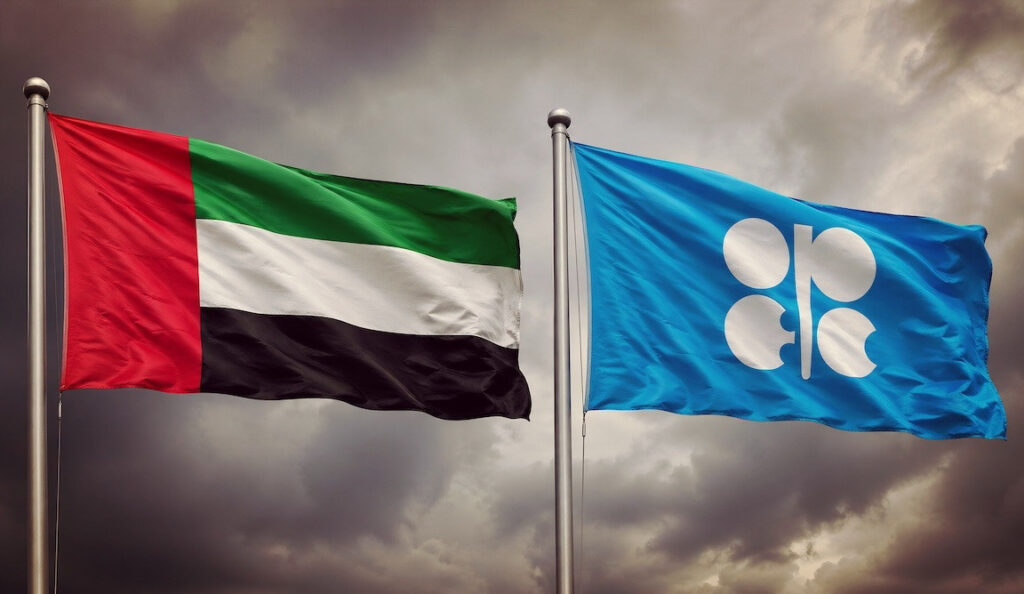
The United Arab Emirates (UAE) has long been one of the most influential members of the Organization of the Petroleum Exporting Countries (OPEC). As one of the world’s leading oil producers, the UAE has traditionally cooperated with OPEC and its allies under the broader OPEC+ framework to regulate global oil supplies and stabilize prices. However, growing tensions over production quotas, investment capacity, and market strategy have increasingly placed the UAE at odds with the group’s leadership. The recent developments, as the UAE breaks from OPEC production quota rules, could have significant implications for the global oil market.
In recent years, the UAE has challenged OPEC’s production quota system, arguing that its expanding production capabilities deserve greater recognition. These disagreements have intensified as Abu Dhabi invested billions of dollars in oil infrastructure while remaining constrained by output limits established through OPEC+ agreements. The situation has sparked debate about the future of OPEC, the balance of power within the cartel, and the evolving dynamics of global energy markets.
This article explores why the UAE has moved away from strict adherence to OPEC production quota rules, the geopolitical and economic implications of this shift, and what it could mean for the future of global oil markets.
Founded in 1960, OPEC was established to coordinate petroleum policies among major oil-producing countries. The organization’s primary objective is to stabilize oil markets by managing production levels among member states.
Production quotas are central to OPEC’s strategy. These quotas determine how much oil each member can produce, helping the organization balance supply and demand while supporting oil prices.
Key goals of OPEC quotas include:
Over time, OPEC expanded into the broader OPEC+ alliance, which includes non-OPEC producers such as Russia. Together, the group controls a substantial share of global oil production.
The UAE possesses some of the world’s largest proven oil reserves, primarily located in Abu Dhabi. Through its national oil company, ADNOC, the country has aggressively invested in expanding production capacity.
Over the past decade, the UAE has pursued a strategy aimed at increasing its maximum production capability while simultaneously diversifying its economy.
Major objectives include:
These ambitions have frequently clashed with OPEC production restrictions, creating friction between Abu Dhabi and other members of the cartel.
The UAE’s dissatisfaction with OPEC quotas did not emerge overnight. For years, Emirati officials argued that the country’s production baseline failed to reflect its actual production capabilities.
Under OPEC+ agreements, production targets are often calculated using historical output levels rather than future capacity investments. This system disadvantaged countries like the UAE that invested heavily in expanding production infrastructure.
While other members struggled with declining output or underinvestment, the UAE developed new oil fields and upgraded existing facilities. Yet its production quotas remained relatively restrictive.
The dispute became increasingly visible during negotiations in 2021 and 2022 when the UAE pushed for a higher baseline from which future production quotas would be calculated.
Recognizing the UAE’s growing production capabilities, OPEC+ eventually agreed to adjust the country’s production baseline.
In June 2024, OPEC+ approved a higher production quota for the UAE, allowing the country to gradually increase output by approximately 300,000 barrels per day during 2025. The agreement raised the UAE’s reference production level to approximately 3.519 million barrels per day. :contentReference[oaicite:0]{index=0}
This decision represented a significant victory for Abu Dhabi and acknowledged years of lobbying efforts aimed at securing a larger share of production within the OPEC+ framework.
The adjustment demonstrated that internal pressures within OPEC were becoming increasingly difficult to ignore.
The UAE invested billions of dollars in expanding production capacity through ADNOC and international partnerships.
Restrictive quotas limited the country’s ability to generate returns on these investments.
Although the UAE has made significant progress in diversifying its economy, oil revenues remain crucial for funding infrastructure, technology initiatives, and economic transformation projects.
Global oil markets are becoming increasingly competitive due to rising production from countries outside OPEC.
Major producers such as the United States, Canada, Brazil, and Guyana have steadily expanded output, reducing OPEC’s influence over global supply.
The UAE feared losing long-term market share by keeping valuable production capacity idle.
Many policymakers recognize that global energy markets are gradually transitioning toward cleaner energy sources.
This has encouraged some oil-producing countries to maximize revenues while demand remains strong.
The UAE’s push against quota restrictions represents more than a simple production dispute. It highlights structural tensions within OPEC itself.
Several challenges have emerged:
Historically, Saudi Arabia has served as OPEC’s de facto leader, often adjusting its own production to stabilize prices.
However, the UAE increasingly questioned whether OPEC’s quota system adequately reflected the realities of modern energy markets.
When major producers exceed quotas or challenge production limits, significant economic consequences can follow.
Higher production increases global supply. If demand does not rise proportionally, prices may decline.
Lower prices can benefit consumers but reduce revenues for producing nations.
Uncertainty regarding quota compliance often increases market volatility.
Investors closely monitor OPEC decisions because production changes can rapidly influence oil prices.
For the UAE, increasing production provides opportunities to generate greater export revenues, particularly during periods of elevated oil prices.
The 2024 OPEC+ decision to grant the UAE additional production capacity illustrates how internal pressure can reshape cartel policies.
The agreement allowed the UAE to gradually increase output while maintaining overall market stability. OPEC+ simultaneously extended broader production cuts totaling several million barrels per day in an effort to support oil prices. :contentReference[oaicite:1]{index=1}
This compromise reflected two competing realities:
While the deal temporarily eased tensions, it also demonstrated the growing difficulty of maintaining unity among producers with different strategic objectives.
Reports from industry analysts and shipping data have raised questions about whether actual UAE production consistently matched official quota limits.
Some market observers noted that UAE export volumes frequently appeared higher than official production allocations. Analysts pointed out that shipborne crude exports often exceeded quota levels during parts of 2024. :contentReference[oaicite:2]{index=2}
These findings fueled speculation that some producers were already operating beyond agreed targets.
Such situations create challenges for OPEC because the organization’s effectiveness depends heavily on member compliance.
The UAE’s growing independence carries significant geopolitical consequences.
Although Saudi Arabia and the UAE remain close partners on many regional issues, economic competition has intensified in recent years.
Both nations seek to become dominant hubs for finance, logistics, tourism, and investment in the Middle East.
Differences over oil production strategies occasionally reveal broader strategic competition.
The UAE’s willingness to challenge quota restrictions could encourage other members to seek similar concessions.
Countries with expanding production capabilities may become less willing to accept limitations that restrict growth.
Increased UAE production could improve energy security for importing nations by adding supply flexibility to global markets.
However, it could also weaken coordinated supply management mechanisms that historically helped stabilize prices.
Some analysts believe the UAE’s actions reflect a broader shift away from rigid production controls.
Several factors support this argument:
As countries invest heavily in production capacity, pressure grows to maximize utilization rather than leave capacity unused.
The UAE’s position is shaped by a unique combination of energy expansion and economic diversification.
Unlike some oil-dependent economies, the UAE has invested heavily in:
At the same time, Abu Dhabi continues expanding oil production capacity.
This dual-track strategy allows the country to maximize current hydrocarbon revenues while preparing for a future in which energy markets may look very different.
The UAE’s departure from strict quota discipline may signal deeper changes within OPEC and the broader energy landscape.
Potential consequences include:
Oil markets have already become more complex due to rising production outside OPEC, geopolitical conflicts, and the global energy transition.
The UAE’s evolving relationship with OPEC adds another layer of uncertainty to an already dynamic market environment.
The UAE remains one of the most influential oil producers in the world.
These figures illustrate why the country’s production policies have such significant implications for global energy markets.
The UAE’s break from traditional OPEC production quota rules represents one of the most significant developments in modern oil politics. Driven by massive investments in production capacity, economic diversification goals, and a desire for greater market flexibility, Abu Dhabi has increasingly challenged a quota system that it believes no longer reflects contemporary market realities.
While OPEC+ has responded by granting higher production allocations, the underlying tensions remain. The UAE’s push for greater production freedom reflects broader challenges facing the cartel, including changing global demand patterns, rising competition from non-OPEC producers, and diverging priorities among member states.
As global energy markets continue to evolve, the UAE’s actions may serve as a blueprint for other producers seeking greater autonomy. Whether this ultimately weakens OPEC’s influence or forces the organization to adapt its governance model remains one of the most important questions facing the global oil industry today.