

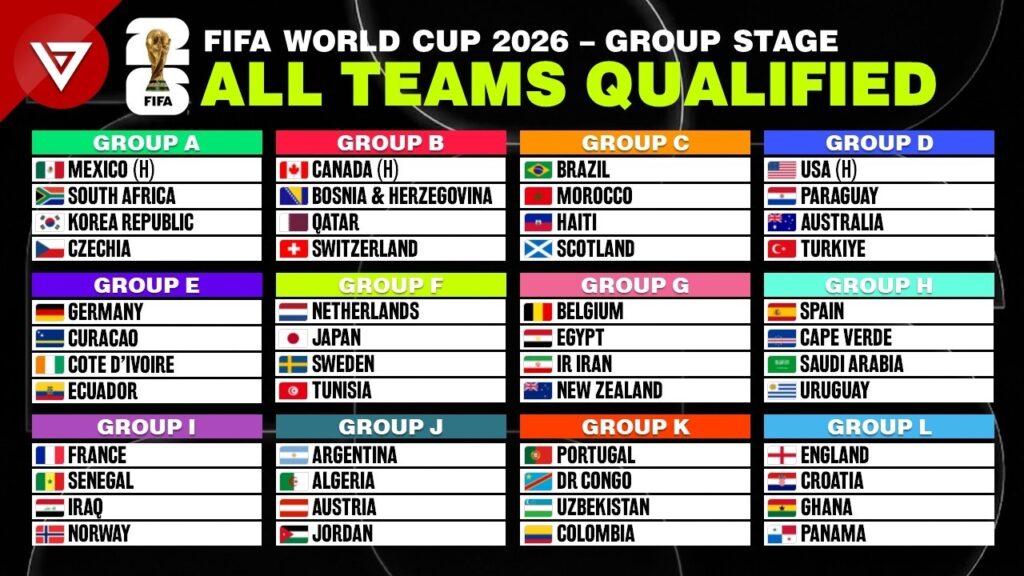
The FIFA World Cup 2026 is set to be the largest and most inclusive tournament in football history. Hosted jointly by the United States, Canada, and Mexico, the competition marks a historic expansion from 32 teams to 48 teams, creating new opportunities for nations across every continent to compete on football’s biggest stage. Below you’ll find the complete list of teams qualified for FIFA World Cup 2026 as the group stage approaches.
The tournament will feature 104 matches played across 16 host cities and stadiums throughout North America. The expanded format has allowed several countries to qualify for their first-ever FIFA World Cup while also welcoming back traditional football powers seeking international glory.
As qualification campaigns concluded across the globe, all 48 participating nations secured their places in what promises to be one of the most diverse and competitive World Cups ever organized. The field includes former champions, emerging football nations, regional powerhouses, and historic debutants. According to FIFA’s finalized qualification list, the 2026 tournament features representatives from every confederation, highlighting football’s growing global reach.
This article provides a complete overview of every qualified team, analyzes the qualification process, highlights major storylines, and examines what fans can expect from the expanded FIFA World Cup 2026.
The 2026 FIFA World Cup introduces the most significant format change in tournament history.
Key changes include:
The expansion was designed to increase global participation while providing more nations with the opportunity to compete at the highest level of international football.
All 48 qualified teams are listed below according to their respective confederations.
The three host countries automatically qualified for the tournament.
This marks Canada’s second consecutive World Cup appearance, Mexico’s 18th participation, and the United States’ return to hosting duties for the first time since 1994.
Asia received an expanded allocation of World Cup places and will be represented by the following nations:
The qualification of Jordan and Uzbekistan represents one of the most significant stories of the entire qualification cycle, as both nations secured their first-ever World Cup appearances.
Africa’s representation increased significantly under the expanded format.
The qualification of Cape Verde stands out as a historic achievement, marking the nation’s first appearance at a FIFA World Cup. Morocco enters the tournament with high expectations following its remarkable semifinal run at the 2022 World Cup.
In addition to the three host nations, several regional teams secured qualification.
Curaçao’s qualification represents another historic debut, while Haiti returns to the World Cup for the first time since 1974. Panama continues its rise as a competitive force in North American football.
South America once again sends some of football’s most powerful nations.
Defending champions Argentina headline the South American contingent, while Brazil maintains its unique record of qualifying for every World Cup in history. Paraguay returns after missing recent tournaments, adding further depth to the South American field.
Oceania secured a direct qualification spot for the first time.
New Zealand’s qualification highlights the benefits of the expanded format and provides the region with increased representation at the global level.
Europe remains the most heavily represented confederation.
Several European storylines stand out, including Norway’s return after a long absence, Scotland’s comeback, and Türkiye’s first World Cup appearance since 2002. Traditional powers such as England, France, Germany, Spain, Portugal, and the Netherlands are again among the favorites.
The expansion to 48 teams has created opportunities for several nations to reach the World Cup for the first time.
Debutants include:
These teams represent the growing competitiveness of football across emerging regions. Their qualification demonstrates how investment in player development, coaching, and infrastructure can elevate national programs to the global stage.
Several nations ended lengthy World Cup droughts.
Norway’s return is particularly notable given the emergence of a talented generation of players, while Scotland’s qualification ends years of frustration for its passionate supporters.
Although the expanded field increases unpredictability, several teams enter the competition as leading contenders.
Argentina arrives as defending champion, while France, Spain, and Brazil possess deep squads filled with world-class talent. Spain’s recent European success and France’s consistent performances make them particularly dangerous contenders.
Several iconic players are expected to attract global attention.
The tournament could represent the final World Cup appearances for Messi and Ronaldo, two of the greatest players in football history. Emerging stars such as Lamine Yamal are also expected to shine.
Morocco enters the 2026 World Cup with elevated expectations.
At the 2022 FIFA World Cup, Morocco became the first African nation to reach the semifinals. That historic achievement transformed perceptions regarding African football and inspired greater investment across the continent.
Key strengths include:
Many analysts believe Morocco could again challenge traditional football powers.
Uzbekistan’s qualification represents years of strategic football development.
The nation has invested heavily in:
Its first-ever World Cup appearance serves as a landmark achievement for Central Asian football and demonstrates the effectiveness of long-term planning.
The increase from 32 to 48 teams offers several advantages.
Critics have raised concerns regarding competitive balance, but supporters argue that broader participation strengthens football’s global appeal.
Several nations could exceed expectations.
These teams possess the talent and organizational structure necessary to challenge established powers in the knockout stages.
The 48 qualified teams are distributed across confederations as follows:
This distribution reflects FIFA’s commitment to increasing global participation while maintaining competitive standards.
Several factors distinguish the 2026 tournament from previous editions.
The combination of these elements creates the potential for one of the most memorable World Cups ever staged.
The FIFA World Cup 2026 marks a historic new chapter in international football. With 48 qualified teams representing every region of the world, the tournament embodies FIFA’s vision of expanding participation while maintaining the prestige of football’s greatest competition. From traditional giants such as Argentina, Brazil, Germany, France, and Spain to first-time participants like Jordan, Uzbekistan, Cape Verde, and Curaçao, the competition promises unprecedented diversity and excitement.
The expanded format creates new opportunities for emerging football nations while providing fans with a broader range of styles, cultures, and stories. Established powers remain favorites, but the increased number of participants also enhances the possibility of surprise results and breakthrough performances.
As the world prepares for the largest FIFA World Cup ever organized, the 48 qualified teams stand ready to compete for football’s most coveted trophy. Whether through legendary veterans seeking one final triumph or ambitious newcomers chasing history, FIFA World Cup 2026 is poised to deliver unforgettable moments on a truly global stage.