

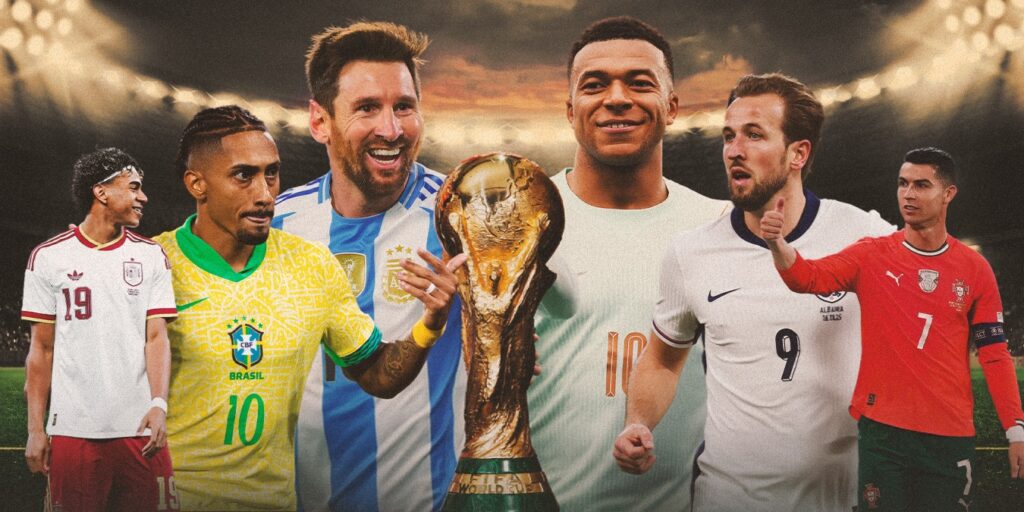
The FIFA World Cup 2026 promises to be one of the most exciting tournaments in football history. Hosted by the United States, Canada, and Mexico, the competition will feature an expanded 48-team format, bringing together the world’s elite football talent on the biggest stage. Many fans are eager to see the best players expected to dominate FIFA World Cup 2026, showcasing their skills and influencing the competition. While team performance ultimately determines success, history has repeatedly shown that extraordinary individual players often define World Cups through unforgettable moments, decisive goals, and match-winning performances.
From legendary figures such as Pelé, Diego Maradona, Zinedine Zidane, Ronaldo Nazário, and Lionel Messi to modern superstars like Kylian Mbappé, football’s greatest tournaments have always been influenced by exceptional individuals. As the 2026 World Cup approaches, a new generation of stars is preparing to leave its mark while established icons continue to pursue international glory.
This article examines the players most likely to dominate FIFA World Cup 2026, analyzing their recent performances, playing styles, strengths, international experience, and potential impact on the tournament.
World Cup success involves far more than club achievements. Players who dominate the tournament typically possess a combination of technical ability, mental resilience, leadership, consistency, and the capacity to perform under immense pressure.
Several factors often separate standout performers:
With seven potential matches or more required to win the expanded tournament, endurance and consistency may become even more important in 2026.
Few players enter the 2026 World Cup with expectations as high as Kylian Mbappé. Already a World Cup winner and one of the most productive international players of his generation, Mbappé possesses the speed, finishing ability, and confidence needed to dominate any tournament.
His World Cup record is already remarkable. He played a pivotal role in France’s 2018 triumph and was the leading scorer in the 2022 tournament. By 2026, he will be entering what many consider the prime years of his career.
Key strengths include:
If France advances deep into the tournament, Mbappé is widely expected to be among the leading candidates for the Golden Ball and Golden Boot awards.
Jude Bellingham has rapidly established himself as one of football’s most complete midfielders. Combining technical excellence, physical strength, tactical intelligence, and leadership, he has become a cornerstone of England’s future.
Unlike many midfielders who specialize in either attacking or defensive responsibilities, Bellingham excels in nearly every aspect of the game.
His strengths include:
England’s hopes of winning their first World Cup since 1966 may depend heavily on Bellingham’s ability to control matches from midfield.
Brazil has always produced attacking stars capable of electrifying World Cups. Vinícius Júnior appears poised to continue that tradition.
Known for his dribbling ability, pace, creativity, and flair, Vinícius has developed into one of the world’s most dangerous attacking players.
His attributes include:
If Brazil enters the tournament among the favorites, Vinícius will likely be the central figure in their offensive strategy.
For years, Norway struggled to qualify for major tournaments despite producing talented players. With Erling Haaland leading the attack, expectations have changed dramatically.
Haaland’s goal-scoring record at club level has been extraordinary. His combination of size, speed, strength, and finishing ability makes him one of the most feared strikers in football.
What makes Haaland particularly dangerous:
If Norway reaches the knockout rounds, Haaland could emerge as one of the tournament’s most influential players.
Among the youngest stars expected to shine in 2026 is Lamine Yamal. Already regarded as one of football’s most exciting talents, Yamal has demonstrated remarkable maturity despite his age.
By the time the World Cup begins, he could be among the tournament’s most feared attackers.
His strengths include:
Spain’s attacking future may revolve around Yamal’s ability to unlock defenses on the biggest stage.
Jamal Musiala has emerged as one of Germany’s brightest stars. His close control, agility, and creativity make him a constant threat in attacking situations.
Germany’s recent struggles in World Cups have increased pressure on the new generation to restore the nation’s status among football’s elite.
Musiala’s qualities include:
If Germany enjoys a deep tournament run, Musiala could be one of its defining figures.
Spain’s possession-based style relies heavily on technically gifted midfielders, and Pedri embodies that tradition.
Pedri’s intelligence, passing range, and positional awareness allow him to dictate the tempo of matches.
Key attributes include:
His influence may be crucial if Spain hopes to challenge for another World Cup title.
Another player expected to make a major impact is Florian Wirtz. His technical brilliance and attacking creativity have made him one of Europe’s most exciting young players.
Wirtz possesses:
The combination of Wirtz and Musiala could form one of the most dangerous creative partnerships at the tournament.
Modern football increasingly emphasizes midfield control, and few players perform that role better than Rodri.
Rodri’s ability to dictate possession, break up opposition attacks, and organize teammates makes him indispensable.
While defensive midfielders rarely receive the same attention as forwards, tournaments are often won by teams with dominant midfield control.
Rodri’s influence could prove decisive for Spain.
Following Argentina’s World Cup triumph in 2022, attention has increasingly shifted toward the next generation of Argentine stars.
Julián Álvarez has emerged as a key figure thanks to his relentless work rate and goal-scoring ability.
His strengths include:
Álvarez may become Argentina’s primary attacking leader in 2026.
Every World Cup introduces new stars to global audiences. Several young players could emerge as breakout performers.
These players possess the talent to become household names during the tournament.
While young stars often capture headlines, experienced players frequently play decisive roles in World Cups.
Veteran leaders contribute:
Teams that successfully blend youth and experience typically perform best on football’s biggest stage.
Historical World Cup data reveals several characteristics common among standout performers:
Many of the players discussed in this article fit these criteria, increasing expectations for their impact in 2026.
Although strikers often receive the most attention, modern World Cups are increasingly influenced by midfielders and versatile attackers.
Positions likely to shape the tournament include:
The tactical evolution of football means influence can come from virtually any area of the pitch.
The Golden Ball is awarded to the tournament’s best player.
Leading candidates include:
The eventual winner will likely come from a team that reaches at least the semifinals.
The FIFA World Cup 2026 is set to showcase an extraordinary collection of football talent. Established superstars such as Kylian Mbappé, Jude Bellingham, Vinícius Júnior, Erling Haaland, and Rodri enter the tournament with immense expectations, while emerging talents like Lamine Yamal, Jamal Musiala, Florian Wirtz, and Endrick could define the next era of international football.
World Cups are often remembered through the performances of iconic individuals who rise to the occasion when pressure is greatest. While team organization and tactical execution remain essential, exceptional players frequently provide the moments that shape football history. The expanded 48-team format ensures more matches, more opportunities, and a larger stage than ever before for the world’s best players to demonstrate their abilities.
Whether it is Mbappé pursuing further greatness, Bellingham leading England’s title ambitions, Vinícius carrying Brazil’s hopes, or a young star announcing themselves to the world, the 2026 FIFA World Cup promises to deliver unforgettable performances from some of the most talented footballers the sport has ever seen.