

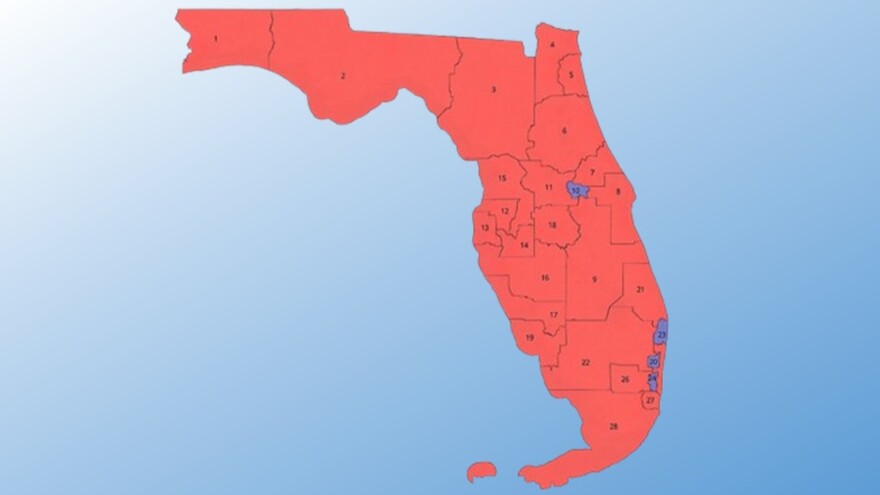
Redistricting has long been one of the most consequential and controversial aspects of American politics. Every ten years, following the U.S. Census, states redraw congressional district boundaries to reflect population changes. While the process is intended to ensure equal representation, it has increasingly become a battleground for partisan competition. The DeSantis Redistricting Plan threatens Democrat House seats, and in recent years, few redistricting efforts have generated as much debate as Florida Governor Ron DeSantis’s congressional redistricting plan.
Supporters argue that the map complies with constitutional requirements and reflects changing demographics across Florida. Critics, however, contend that the plan significantly weakens Democratic representation, particularly among minority communities, and could reshape Florida’s congressional delegation for years to come. The controversy has sparked lawsuits, political protests, and national discussions about voting rights, representation, and the future of congressional elections.
This article examines the origins of the DeSantis redistricting plan, its impact on Democratic House seats, the legal and constitutional debates surrounding the map, and the broader implications for American democracy.
Redistricting is the process of redrawing electoral district boundaries following the decennial census. The goal is to ensure that districts contain roughly equal populations, thereby maintaining the principle of “one person, one vote.”
Congressional redistricting affects representation in the U.S. House of Representatives and can significantly influence election outcomes.
Key objectives of redistricting include:
Because political control often depends on district boundaries, redistricting has become highly partisan in many states.
Florida is one of the fastest-growing states in the United States and plays a critical role in national politics. The state’s population growth has led to additional congressional representation and increased influence in presidential and congressional elections.
Several factors contribute to Florida’s political significance:
As Florida’s importance has grown, so has the significance of its congressional district boundaries.
Following the 2020 Census, Florida gained an additional congressional seat due to population growth. The Florida Legislature initially developed a congressional map, but Governor Ron DeSantis objected to portions of the proposal and advocated for a different approach.
DeSantis argued that certain districts were constitutionally problematic and that the state should adopt a map that better reflected legal standards. His administration subsequently introduced an alternative map that ultimately became the basis for Florida’s congressional boundaries.
The plan marked a rare instance in which a governor played a direct and highly influential role in congressional redistricting.
Democratic leaders and voting-rights advocates argue that the DeSantis map disproportionately benefits Republicans while reducing opportunities for Democratic candidates to win congressional seats.
Their concerns center on several issues:
Critics contend that these changes could make it significantly more difficult for Democrats to compete in certain regions of the state.
One of the most debated aspects of the DeSantis plan involved a congressional district in North Florida that had previously been designed to provide minority voters, particularly Black voters, an opportunity to elect candidates of their choice.
The district had become a symbol of minority representation and voting-rights protections in Florida.
Under the revised map, the district was dismantled and redistributed into neighboring districts. Supporters of the change argued that the original district’s configuration raised constitutional concerns, while opponents claimed the move weakened minority political influence.
This issue quickly became the focal point of multiple legal challenges.
The debate surrounding the DeSantis map cannot be separated from the broader issue of partisan gerrymandering.
Gerrymandering refers to the practice of drawing district boundaries in a manner that benefits a particular political party.
Common gerrymandering strategies include:
Critics argue that the Florida map represents a form of partisan gerrymandering designed to increase Republican electoral strength. Supporters counter that political considerations inevitably play a role in redistricting and that the map remains legally defensible.
The most immediate consequence of the DeSantis redistricting plan is its potential impact on Democratic representation in the U.S. House of Representatives.
Political analysts have suggested that the map could shift several congressional seats toward Republican candidates, potentially reducing the number of districts where Democrats can compete effectively.
Possible outcomes include:
Because control of the House of Representatives is often decided by a relatively small number of seats, even modest changes in Florida could have national consequences.
Florida is not the first state to experience intense redistricting disputes.
Across the United States, states such as Texas, North Carolina, Pennsylvania, and Wisconsin have faced legal challenges regarding district boundaries and allegations of partisan manipulation.
These cases illustrate several recurring themes:
The Florida debate reflects broader national tensions over how representative democracy should function in an increasingly polarized political environment.
The DeSantis map quickly became the subject of multiple lawsuits.
Plaintiffs argued that the redistricting plan violated provisions of the Florida Constitution designed to protect minority voting rights and prevent unfair political favoritism.
Legal disputes focused on questions such as:
These legal battles have highlighted the complex interaction between federal law, state constitutional provisions, and electoral representation.
At the heart of the controversy lies a broader debate about voting rights.
Supporters of voting-rights protections argue that redistricting should preserve opportunities for historically marginalized communities to elect representatives who reflect their interests.
Advocates point to decades of progress achieved through voting-rights legislation and court decisions.
Opponents of race-conscious districting argue that electoral maps should prioritize geographic and constitutional considerations rather than racial classifications.
The Florida case illustrates the ongoing national debate regarding how best to balance these competing principles.
Political observers widely agree that the DeSantis map is likely to strengthen Republican electoral prospects in Florida.
Several factors contribute to this assessment:
For Republicans, the map represents an opportunity to solidify gains made in Florida over the past decade.
Florida’s evolving demographics have played a significant role in redistricting debates.
The state has experienced substantial migration from other parts of the country, changing voting patterns and political alignments.
Important demographic trends include:
These demographic shifts complicate efforts to predict future electoral outcomes.
Florida’s congressional delegation is among the largest in the nation, making redistricting outcomes particularly important.
If the map results in additional Republican seats, it could influence the balance of power in Congress.
Potential national effects include:
Because congressional majorities are often narrow, even a small shift in representation can have significant political consequences.
Supporters of the DeSantis plan maintain that the map complies with constitutional requirements and reflects legitimate policy objectives.
Common arguments include:
Supporters argue that criticism often stems from dissatisfaction with likely electoral outcomes rather than legal deficiencies.
Opponents continue to raise concerns regarding representation and fairness.
Their primary arguments include:
These concerns have fueled continued political activism and legal challenges.
The controversy has renewed interest in redistricting reform nationwide.
Proposed reforms include:
Advocates argue that such reforms could reduce partisan conflicts and improve public confidence in electoral systems.
The DeSantis redistricting plan represents one of the most significant and controversial political developments in Florida’s recent history. By reshaping congressional district boundaries, the plan has the potential to alter Democratic electoral prospects, strengthen Republican representation, and influence the balance of power in the U.S. House of Representatives.
The debate extends far beyond partisan politics. It touches on fundamental questions about representation, voting rights, constitutional interpretation, and the nature of democratic governance. Supporters view the map as a legally justified response to constitutional concerns, while critics see it as a threat to minority representation and electoral fairness.
As court challenges continue and future elections unfold, the long-term consequences of the redistricting plan will become clearer. Regardless of one’s political perspective, the Florida case underscores the enormous importance of redistricting in shaping electoral outcomes and determining how representative democracy functions in the United States.