

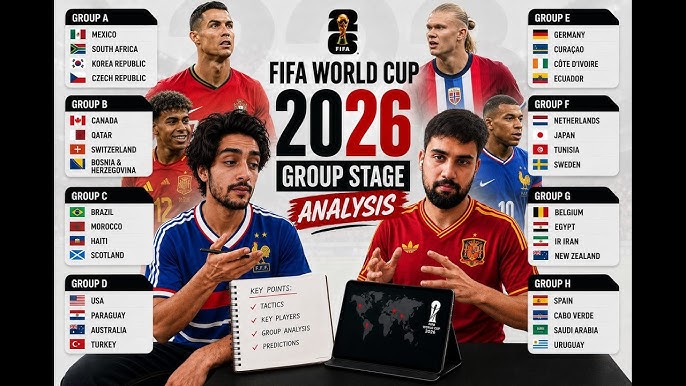
The FIFA World Cup 2026 is set to be the most ambitious and expansive tournament in football history. Hosted jointly by the United States, Canada, and Mexico, the competition will feature 48 teams for the first time, expanding from the traditional 32-team format. This historic change introduces 12 groups of four teams each, with the top two teams from every group and the eight best third-place finishers advancing to the Round of 32. FIFA World Cup 2026 Group Stage Predictions and Analysis become more intriguing than ever, as the expanded structure creates more opportunities for emerging nations while increasing the complexity of predicting group-stage outcomes.
With the groups now finalized and national team squads largely confirmed, football analysts and fans worldwide are debating which teams will dominate, which nations could surprise, and where the biggest upsets may occur. This article provides a comprehensive analysis of the 2026 FIFA World Cup group stage, examining key contenders, potential dark horses, tactical matchups, and projected qualifiers.
The 2026 tournament introduces a significantly larger format than previous editions. Forty-eight nations are divided into 12 groups of four teams. Each team plays three group-stage matches. The top two teams from each group automatically advance, while the eight best third-place teams also qualify for the knockout stage. This means 32 teams will progress beyond the group stage. Recent FIFA guidance confirms this format and qualification structure.
This format increases the likelihood that strong teams survive difficult groups while giving underdogs a realistic path to the knockout rounds.
Several major trends shape expectations for the group stage.
The combination of elite traditional powers and rising football nations suggests that the 2026 World Cup could feature some of the most competitive groups in tournament history.
Mexico enters the tournament with the advantage of hosting matches and extensive World Cup experience. South Korea possesses a disciplined squad capable of upsetting stronger opponents. The Czech Republic offers European tactical organization, while South Africa brings athleticism and defensive resilience.
Mexico’s home support and tournament experience make them favorites to top the group. South Korea’s technical quality and speed on the counterattack should give them an edge over the remaining teams.
This group combines a host nation with experienced tournament participants. Switzerland has consistently advanced beyond group stages in recent major tournaments, while Italy’s return to the World Cup adds significant intrigue.
Italy’s defensive structure and tournament pedigree make them favorites. Switzerland’s consistency should secure second place, though Canada could challenge strongly with home support.
Brazil remains one of the tournament favorites, while Morocco arrives after becoming the first African nation to reach a World Cup semifinal in 2022. Scotland’s return to the global stage adds excitement.
Brazil should dominate possession and create numerous scoring opportunities. Morocco’s defensive discipline and tactical organization make them strong candidates for second place.
This group may prove more competitive than many expect. The United States benefits from home advantage, while Türkiye and Paraguay possess considerable international experience.
The United States should benefit from familiar conditions and crowd support. Türkiye’s technical quality may narrowly secure second place ahead of Paraguay.
Germany enters the tournament seeking redemption after disappointing recent World Cup performances. Ecuador and Ivory Coast are capable of producing surprises.
Germany’s talent depth should be enough to win the group. Ecuador’s athleticism and attacking pace could help them edge Ivory Coast.
This group offers one of the most intriguing tactical battles of the tournament. Japan has developed into a formidable football nation, while Ukraine brings determination and technical quality.
The Netherlands remain favorites due to squad depth. Japan’s recent performances against elite opponents suggest they can secure second place.
Belgium continues its transition into a new generation, while Egypt hopes to make a deeper World Cup impact with its experienced squad.
Belgium’s quality should see them through comfortably. Egypt’s attacking talent may prove decisive in securing second place.
Many analysts consider this one of the strongest groups in the tournament. Spain’s possession-based style faces a stern challenge from Uruguay’s intensity and experience.
Spain’s youthful talent and tactical sophistication should deliver first place. Uruguay’s blend of experience and physicality makes them favorites for second.
This group could produce some of the tournament’s most entertaining matches. France remains a title contender, while Norway boasts world-class attacking talent.
France’s depth and quality should secure top spot. Norway’s attacking firepower gives them a slight advantage over Senegal.
Defending champions Argentina enter with significant expectations. Austria has quietly become one of Europe’s most organized teams.
Argentina should top the group comfortably. Austria’s disciplined structure and tactical flexibility should earn second place.
This group features a fascinating mix of established powers and emerging nations.
Portugal’s talent-rich squad should finish first. Colombia’s balance between attack and defense makes them favorites for second.
England enters as one of the favorites for the title, while Croatia continues to demonstrate remarkable consistency on the international stage.
England’s squad depth should help them top the group. Croatia’s tournament experience gives them a slight edge over Ghana.
Every World Cup produces unexpected success stories. Several teams appear well-positioned to exceed expectations.
These nations could emerge as surprise contenders in the knockout rounds.
Several groups stand out for their competitiveness.
In these groups, even minor mistakes could determine qualification.
Several stars are expected to play decisive roles.
The performances of these players could heavily influence group standings and knockout qualification.
Historical World Cup data reveals several trends.
These patterns provide useful context when evaluating potential outcomes.
The FIFA World Cup 2026 promises to be unlike any previous edition of the tournament. The expanded 48-team format introduces greater diversity, more matches, and increased opportunities for emerging football nations to challenge traditional powers. While favorites such as Argentina, France, Brazil, England, Spain, Germany, and Portugal are expected to dominate their groups, several dark horses possess the quality to surprise the football world.
Groups H and I appear particularly competitive, while host nations Mexico, Canada, and the United States will seek to capitalize on home support. The introduction of third-place qualification also adds a new strategic dimension, meaning that every goal and every point could prove crucial.
As the world’s greatest football tournament approaches, the group stage is set to deliver drama, excitement, and unforgettable moments. Whether established giants maintain their dominance or new contenders emerge, the 2026 World Cup promises to be a landmark event in football history.