

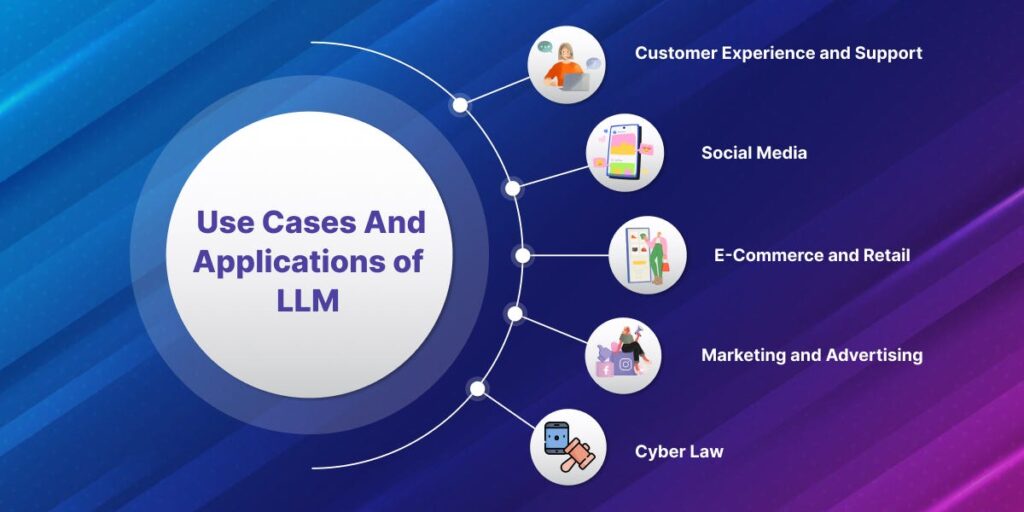
Large Language Models (LLMs) have rapidly transformed the technology landscape, reshaping how businesses, governments, educators, and individuals interact with information. From intelligent chatbots and virtual assistants to code generation and medical research, LLMs are now powering a new generation of AI-driven solutions. Large Language Model Use Cases and Applications span a wide range of fields, making these models valuable tools across industries. These models, trained on massive datasets using deep learning architectures, can understand, generate, summarize, translate, and analyze human language with remarkable sophistication.
The rise of generative AI platforms has accelerated enterprise adoption at an unprecedented pace. According to enterprise AI research, organizations are increasingly integrating AI into multi-step workflows, customer interactions, and operational systems. OpenAI reported that enterprise AI adoption has deepened significantly, with workplace AI usage growing rapidly across industries.
This article explores the most impactful Large Language Model use cases and applications across industries. It examines how LLMs work, where they create value, their limitations, and the future trends shaping the next era of AI innovation.
Large Language Models are advanced artificial intelligence systems trained on enormous amounts of text data. Using transformer-based neural network architectures, these systems learn language patterns, grammar, reasoning structures, and contextual relationships between words and concepts.
Popular examples of LLMs include GPT models, Claude, Gemini, Llama, and Qwen. These systems can:
Modern LLMs increasingly support multimodal capabilities, meaning they can process not only text but also images, audio, and video inputs. This expansion dramatically increases their practical applications across industries.
LLMs matter because they reduce the friction between humans and technology. Instead of learning complex interfaces or coding languages, users can simply communicate using natural language.
Organizations are investing heavily in LLM technologies due to measurable productivity gains and automation benefits. Research from enterprise AI studies indicates that AI adoption is accelerating rapidly, with many organizations increasing spending on generative AI solutions.
Key reasons behind the explosive growth of LLM adoption include:
One of the most widespread applications of LLMs is AI-powered customer support. Businesses now deploy intelligent chatbots capable of handling customer inquiries 24/7.
Unlike traditional rule-based bots, LLM-driven assistants understand context, intent, and conversational nuance. They can:
Enterprise studies show customer support remains one of the leading use cases for LLM adoption.
For example, e-commerce companies use AI assistants to manage order tracking, returns, and customer engagement at scale. Financial institutions deploy conversational AI for banking inquiries, fraud alerts, and loan assistance.
Content generation is another transformative use case. LLMs can create:
Marketing teams leverage LLMs to dramatically reduce production time while scaling personalized campaigns.
For example, a digital marketing agency may use AI to generate hundreds of ad variations optimized for different audience segments. Publishers use LLMs for article outlines, summaries, and headline generation.
Research analyzing LLM-assisted writing found widespread adoption across corporate communications, job postings, and public communications.
Software engineering has become one of the most influential domains for LLM applications. AI coding assistants can:
Platforms like AI-powered coding assistants integrate directly into development environments, helping programmers write code faster and more efficiently.
Enterprise reports indicate developer productivity is among the top enterprise use cases for LLMs.
Case studies show development teams using AI coding tools can significantly reduce repetitive programming tasks, allowing engineers to focus on architecture and innovation.
Healthcare organizations are increasingly adopting LLMs to improve diagnostics, patient communication, and medical research.
Applications include:
For instance, hospitals use AI to transcribe physician-patient conversations and generate structured clinical notes automatically. Researchers use LLMs to analyze massive datasets of scientific literature, accelerating discoveries.
However, healthcare remains highly regulated, and concerns about hallucinations, accuracy, and privacy continue to limit fully autonomous deployment.
Education has become one of the most promising sectors for LLM adoption. AI tutors and personalized learning systems can adapt educational content based on individual student needs.
Educational applications include:
Students can receive instant explanations, interactive examples, and personalized study plans. Teachers benefit from automated grading assistance and content preparation tools.
Universities are also exploring AI-assisted research and academic writing support.
Law firms and corporate legal departments are adopting LLMs to streamline document-heavy workflows.
LLMs can:
Because legal work involves extensive text analysis, LLMs are particularly effective at reducing administrative burdens.
For example, legal teams may use AI to analyze thousands of pages of contracts during mergers and acquisitions. Compliance departments can monitor policy changes and regulatory updates automatically.
The financial sector has emerged as a major adopter of LLM technologies.
Applications include:
Investment firms use LLMs to analyze news, earnings reports, and market trends. Banks deploy AI assistants for customer interactions and internal operational workflows.
However, financial institutions remain cautious due to concerns around data privacy, explainability, and regulatory compliance.
Human resource departments increasingly rely on LLMs to optimize recruitment and employee management.
Common applications include:
AI-powered recruitment systems can analyze resumes, identify relevant skills, and match candidates to positions faster than traditional methods.
Companies also use internal AI assistants to answer employee questions about benefits, policies, and procedures.
Cybersecurity professionals are beginning to use LLMs for threat analysis and incident response support.
Applications include:
Research into cybersecurity adoption shows practitioners use LLMs primarily for productivity-oriented tasks while remaining cautious about autonomous decision-making due to reliability concerns.
Organizations generate massive volumes of internal knowledge that often remain difficult to access.
LLMs enable intelligent enterprise search systems capable of understanding natural language queries and retrieving relevant information from internal documents.
Applications include:
Consulting firms, pharmaceutical companies, and research institutions increasingly use AI systems to accelerate information discovery.
Retail companies use LLMs to improve customer experiences and optimize operations.
Applications include:
Online retailers use conversational AI to guide customers through purchases and answer product-related questions.
Manufacturers use LLMs for:
Industrial AI systems can interpret maintenance manuals, summarize operational reports, and assist technicians with troubleshooting procedures.
Media companies increasingly rely on LLMs for:
Streaming platforms also use AI to generate personalized recommendations and enhance content discovery.
Enterprise AI adoption has accelerated rapidly in recent years. Research indicates organizations are moving beyond experimentation toward operational deployment.
Businesses are integrating AI into workflows such as:
Studies suggest organizations increasingly use hybrid AI strategies that combine proprietary and open-source models.
Software development teams have seen some of the fastest ROI from LLM deployment.
AI coding assistants help developers:
Many enterprises report substantial productivity improvements in development workflows after integrating AI coding tools.
Customer service automation has become one of the clearest examples of LLM value creation.
Large organizations now use AI systems to:
Retailers, airlines, banks, and telecommunications providers increasingly rely on conversational AI for first-line customer support.
LLMs automate repetitive cognitive tasks, allowing employees to focus on higher-value activities.
AI systems can simultaneously support millions of users, making them highly scalable for global organizations.
Businesses can reduce operational expenses through automation and workflow optimization.
LLMs help organizations analyze large volumes of information rapidly.
Natural language interfaces make technology easier to use for non-technical users.
One of the biggest challenges is hallucination — when AI generates incorrect or fabricated information confidently.
This issue remains especially concerning in:
Organizations remain concerned about sensitive information exposure.
Research indicates security and privacy concerns remain among the top barriers to enterprise LLM adoption.
LLMs can reflect biases present in their training data, potentially leading to unfair or discriminatory outputs.
Training and operating large AI models requires significant computational resources and energy consumption.
Research on enterprise AI cost transparency highlights how token-based pricing can create budgeting uncertainty for organizations.
Governments worldwide are developing AI regulations related to:
While massive frontier models dominate headlines, many enterprises are exploring Small Language Models (SLMs) for specialized applications.
SLMs offer advantages such as:
Industry analysis suggests enterprises increasingly adopt hybrid strategies using both LLMs and smaller domain-specific models.
The next generation of AI systems will increasingly act autonomously.
Agentic AI refers to systems capable of:
Research into enterprise AI benchmarks highlights growing interest in evaluating real-world agentic capabilities.
Future models will seamlessly integrate text, image, video, and audio understanding into unified systems.
This will expand applications across:
AI assistants will become increasingly personalized, adapting to individual user preferences, workflows, and communication styles.
Open-source models are rapidly gaining enterprise traction due to cost efficiency and data sovereignty benefits.
As adoption grows, organizations will invest more heavily in AI governance frameworks, risk management, and compliance systems.
Organizations should prioritize areas where AI can create immediate operational value.
Human review remains essential for high-risk applications.
Strong governance and security protocols are critical for enterprise deployment.
Successful AI adoption requires workforce education and AI literacy programs.
Organizations should define clear metrics for productivity, efficiency, and customer impact.
Large Language Models are reshaping the modern digital economy. Their ability to understand, generate, and reason with human language has unlocked transformative applications across nearly every industry. From customer service and software development to healthcare, finance, education, and cybersecurity, LLMs are becoming foundational tools for productivity, automation, and innovation.
Organizations worldwide are rapidly integrating AI into operational workflows, with enterprise adoption accelerating at remarkable speed. While challenges around privacy, accuracy, governance, and ethics remain significant, the long-term trajectory of LLM technology points toward deeper integration into business systems and everyday life.
The next era of AI will likely involve autonomous agents, multimodal systems, and highly personalized assistants capable of collaborating with humans in increasingly sophisticated ways. Businesses that strategically adopt and govern these technologies effectively will gain substantial competitive advantages in efficiency, innovation, and customer experience.
Ultimately, Large Language Models are not merely another software trend — they represent a fundamental shift in how humans interact with information, technology, and intelligent systems.